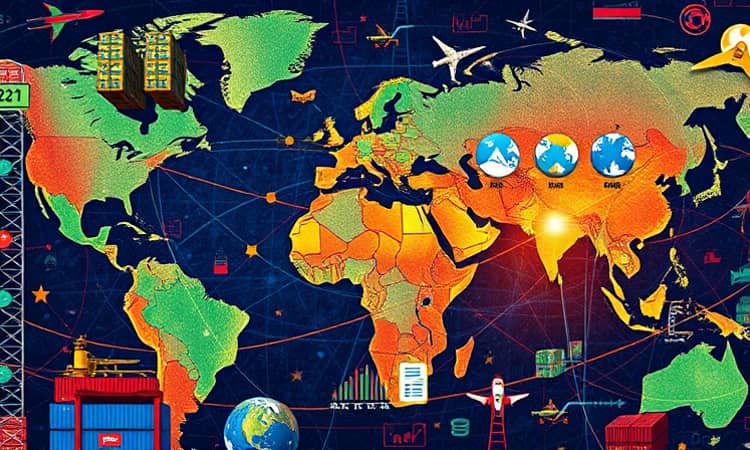
Global commerce has never been more dynamic. As nations navigate emerging technologies, strategic rivalries, and evolving consumer demands, the world’s trading landscape is transforming before our eyes. This article explores the sweeping trends, structural shifts, and policy forces that will shape global trade in 2026 and beyond, offering actionable insights to businesses, policymakers, and stakeholders ready to seize new opportunities.
From a record $35 trillion trade volume in 2025 to a projection of 0.5% growth in 2026, the figures underscore both resilience and caution. While some industries soar, others adjust to tighter trade conditions. Understanding these forces is essential for anyone seeking to thrive amid uncertainty.
Executive Overview & Key Statistics
In 2025, global trade reached levels never seen before, only to face a modest slowdown as supply chains adjust and geopolitical tensions rise. The World Trade Organization projects slowing global economic growth at 2.6% in 2026, with developing markets (excluding China) moderating to 4.2%.
Major economies will experience varied trajectories. While the United States and Europe face modest demand and fiscal constraints, China and India continue to drive significant outbound flows. Among key forecasts for 2026 are listed below:
These figures reflect a delicate balance: advanced economies adjusting to post-pandemic realities and emerging markets leveraging shifting trade corridors.
Structural Shifts: Key Market Dynamics
Several structural forces are reshaping trade patterns. Technological breakthroughs, supply chain diversification, and regional integration initiatives are rewriting the rules of engagement.
One of the most profound shifts is the ascent of Asia in strategic industries. With eight of the top ten chip exporters located in East and Southeast Asia, the semiconductor market is set to reach $750 billion in 2026 and nearly $2 trillion by the early 2030s. This Asian chip manufacturing dominance is driving innovation across electronics and electric vehicles.
Meanwhile, China’s exporters are pivoting toward Europe to bypass tightening U.S. restrictions, creating intense competition for local producers. The nation’s first-ever trillion-dollar trade surplus in 2025 underscores its expanding global footprint.
- The Asian chip supply chain accelerating tech exports
- China’s market pivot intensifying European competition
- Vietnam’s diversified manufacturing base fuelling export growth
- Mexico’s gains from the U.S.-China trade war
- India emerging as the fourth largest global economy
- Russia facing shrinking import demand due to conflict
- Egypt leading global apparel export growth
- U.S. regional ports diversifying cargo flows
- U.S.-China aircraft trade as an outlier in bilateral exchange
- Surge in critical minerals and electric vehicle trade
Policy Uncertainty: Tariffs and Protectionism
Protectionist measures continue to reshape trade patterns. The sharp rise in the effective U.S. tariff rate to approximately 15%—the highest since the 1930s—has reverberated across industries, disrupting established supply chains and incentivizing relocation.
Governments worldwide are expected to wield tariffs and other restrictions strategically in 2026. From additional Section 232 duties on semiconductor equipment and critical minerals in the United States to carbon border adjustments in the European Union, the policy landscape is more fluid than ever.
Businesses must navigate this flux carefully. Frequent shifts hinder long-term planning, inflate costs, and compel firms to reassess supplier portfolios. Smaller economies, with limited diversification, remain especially vulnerable to sudden spikes in trade barriers.
- United States: Expanded Section 232 tariffs on strategic industries
- European Union: Carbon border mechanism launching in 2026
- Global rise in manufacturing-focused tariffs, increasing costs
- New container shipping duties projected to add $2 billion in costs by 2026
South-South Trade and Value Chain Reconfiguration
As demand in advanced markets cools, developing economies are deepening ties with one another. South-South merchandise exports surged from $0.5 trillion in 1995 to $6.8 trillion in 2025, now accounting for 57% of developing-country exports.
Asia’s regional value chains, dominated by high- and medium-tech manufacturing, remain the primary catalyst. Africa, too, is shifting more than half of its exports to fellow developing partners, reflecting growing intra-regional sourcing and consumption.
Amid geopolitical tensions, firms are diversifying suppliers and relocating production closer to key markets. This reconfiguration enhances resilience and mitigates risk, but requires careful logistical planning and investment.
- Diversify supplier base to reduce geopolitical exposure
- Relocate production nearer to end markets for agility
- Leverage regional trade agreements to optimize tariffs
Digital Transformation, Environmental Initiatives, and the Road Ahead
Services trade, driven by digitally deliverable offerings, continues to expand, yet digital gaps persist in least developed countries. Closing the digital divide is critical to unlocking broader participation and fostering inclusive growth.
Environmental considerations are converging with trade policy. Clean-energy technologies could represent a $640 billion annual market by 2030, and enhanced national pledges may cut emissions by 12% by 2035. Industries in electric vehicles, critical minerals, and renewable energy components will be at the forefront of this green transition.
Multilateral frameworks face pressure from rising unilateralism. The upcoming WTO ministerial in Yaoundé will test the resilience of global trade rules. Outcomes will determine whether the system adapts to new realities or fragments further, challenging firms and governments to navigate an uncertain horizon.
Logistics and container shipping remain vital arteries of commerce. After a modest 2.1% global volume rise in October 2025, the U.S. saw an 8% contraction in inbound shipments, underscoring the interplay between policy and trade flows.
In this evolving environment, agility, foresight, and collaboration are indispensable. Stakeholders must harness data, embrace innovation, and build resilient networks to capture emerging opportunities and withstand disruptions.
The tapestry of global trade is more intricate than ever. By understanding the shifting patterns, policy dynamics, and technological drivers at play, businesses and nations can chart strategic courses toward sustainable growth and shared prosperity.