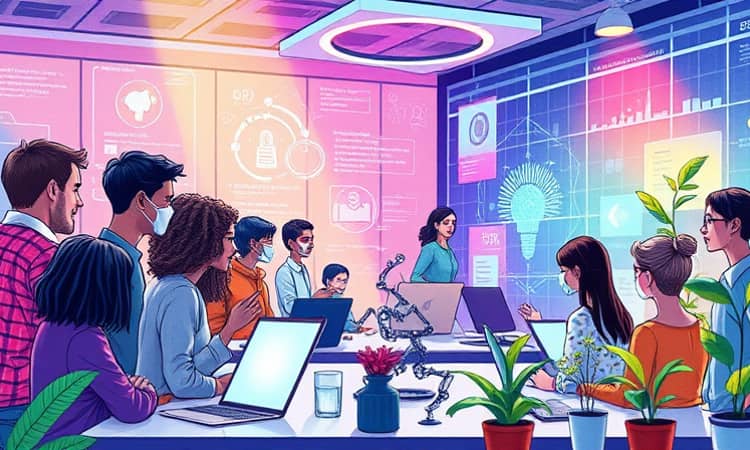
The landscape of work is undergoing a seismic shift, driven by artificial intelligence and evolving human needs.
This transformation calls for a bold reimagining of how we value and develop human capital in organizations.
It's not just about adopting new tools; it's about fostering a blend of humans and machines that unlocks unprecedented potential.
As we stand at this crossroads, the choices we make today will shape productivity, innovation, and wellbeing for decades to come.
Embrace this change with an open mind and a strategic vision.
AI as a Workforce Partner, Not Just a Tool
Organizations are moving beyond viewing AI as a simple automation feature.
Instead, they are managing a parallel agent workforce that requires careful oversight and integration.
This shift demands new frameworks for governance and collaboration.
By 2026, a significant portion of enterprise applications will include task-specific AI agents.
However, without clear strategies, many projects may fail due to unclear returns and rising costs.
- Develop agent orchestration infrastructure with proper permissions and escalation paths.
- Implement quality thresholds and cost controls to ensure accountability.
- Focus on reducing employee effort in friction-filled moments, not just saving time.
This approach prioritizes human experience over mere efficiency gains.
Redesigning Workforce Models Around Skills
The traditional job description is becoming obsolete in the face of rapid change.
Organizations must adopt skills-based workforce design to enhance adaptability and internal mobility.
This involves breaking down roles into tasks and assigning them strategically.
- Build skills ecosystems that support continuous learning and reskilling.
- Invest in robust learning infrastructures to upskill employees effectively.
- Prioritize recruiting work process experts with creativity and systems thinking.
Moreover, workers are seeking AI-proof careers in skilled trades as automation advances.
This trend highlights the need for diverse career pathways and resilience.
Navigating Emerging Compensation and Governance Issues
AI technologies are creating digital twins that replicate employee knowledge and behaviors.
This raises complex questions about ongoing use of digital likeness and compensation rights.
Employees may demand payment for their contributions long after leaving an organization.
Organizations must update AI governance to protect and reward these aspects.
Addressing these issues proactively can prevent disputes and foster trust.
HR's Expanding Mandate in a Changing World
HR is evolving from a support function to a strategic operator guiding continuous change.
CHROs must navigate pressures for growth, AI integration, and shifting employment deals.
This includes enhancing security by focusing on behavioral aspects of insider threats.
- Increase investment in psychological safety and clarity over mere engagement metrics.
- Update recruiting to prioritize AI judgment and critical thinking over technical skills.
- Lead efforts in organizational process redesign for systemic improvements.
By doing so, HR can drive resilience and innovation across the enterprise.
Prioritizing Employee Experience and Wellbeing
Burnout has escalated to a board-level business risk affecting productivity and compliance.
Leading companies are experimenting with innovative solutions to mitigate this.
- Pilot four-day work weeks and shorter workdays to reduce stress.
- Create protected deep-work windows and structured pause periods.
- Treat time as a strategic resource, not just an operational constraint.
These measures enhance mental health and sustain long-term performance.
Organizations must also foster belonging through clear career pathways and upskilling opportunities.
Developing Adaptive Leadership for Resilience
Traditional leadership models are giving way to adaptive approaches that emphasize learning.
Leaders must cultivate environments where employees feel safe to innovate and navigate ambiguity.
- Develop skills in change management and team resilience building.
- Empower middle managers with training to recognize burnout early.
- Focus on fostering psychological safety and continuous learning cultures.
This shift ensures organizations can thrive amidst constant disruption.
Shifting Critical Capabilities for the AI Era
As AI accelerates access to information, judgment becomes the critical human capability.
Organizations must redirect learning budgets toward developing essential skills.
- Enhance critical thinking, analytical judgment, and problem-solving abilities.
- Improve data literacy across all levels of the organization.
- Embed these skills into the entire employee lifecycle, not just standalone courses.
This prepares teams to make informed decisions in complex scenarios.
Recalibrating Work Culture for the Future
Work culture is in an era of recalibration due to AI fears and economic volatility.
This requires renewed emphasis on structured pathways and a sense of belonging.
The form of work is changing, influencing how value is defined and trust is maintained.
By investing in clarity, connection, and purpose, organizations can stabilize their cultures.
Strategic Imperatives for HR Leaders
To succeed, HR leaders must focus on actionable priorities that balance innovation with ethics.
- Establish AI governance frameworks that ensure compliance and ethical use.
- Invest in skills infrastructure, including learning platforms and capability assessments.
- Redesign the employee value proposition to address flexibility, development, and wellbeing.
- Build HR analytics capabilities for predictive decision-making and insights.
- Create regulatory resilience systems to adapt to evolving compliance requirements.
- Develop leadership pipelines focused on adaptive skills and change management.
These steps lay the foundation for sustainable growth and employee satisfaction.
Addressing Implementation Challenges Head-On
Despite recognizing the importance of AI upskilling, many organizations lag in implementation.
A critical gap exists in strategic AI planning, with companies lacking clear roadmaps.
The future demands a new labor architecture blending humans and machines.
Competitive advantage will come from mastering the management of non-human labor.
- Bridge skills gaps by prioritizing skills-based hiring and training initiatives.
- Develop comprehensive AI deployment strategies to avoid project failures.
- Focus on exposing and addressing organizational weaknesses through systemic redesign.
By tackling these challenges proactively, organizations can unlock true innovation and resilience in the evolving world of work.