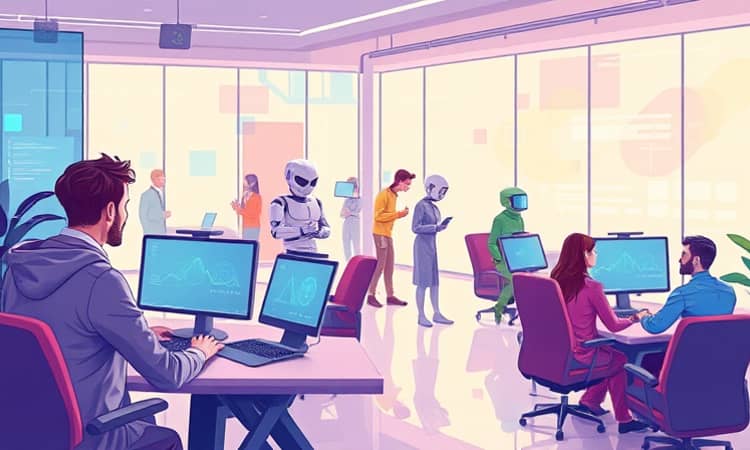
The world of work is on the brink of a profound transformation, driven by rapid technological advances and shifting labor dynamics.
By 2026, businesses and individuals must navigate a landscape where AI-driven job redesign reshapes traditional roles and demands new skills.
This evolution presents both challenges and unprecedented opportunities for growth and innovation, making it crucial to understand and invest in the changing workforce.
Navigating Labor Market Trends
Recent data reveals a labor market in flux, with growth slowing but resilience persisting in key areas.
Non-farm payrolls have dipped to monthly averages as low as 35,000, a stark contrast to earlier expectations.
This slowdown is compounded by a tight labor supply squeeze affecting prime-age workers, which could redefine economic strategies.
The following table summarizes key metrics that highlight these shifts, providing a snapshot of the current environment.
These trends underscore a broader economic narrative where job creation is moderating.
Yet, low layoff rates and solid income growth indicate underlying stability in the workforce.
Investors and employers must adapt to this slow hiring and slow firing environment to maintain competitiveness.
The Rise of AI and Automation
AI is no longer just a tool; it is becoming an integral part of the labor force, redefining how work is done.
Job redesign involves breaking down roles into tasks that can be assigned to humans or AI systems, enhancing efficiency.
This shift is expected to disrupt nearly 40% of skills within five years, demanding rapid adaptation.
Key aspects of this transformation include:
- Wholesale breakdown of traditional roles into AI-managed tasks.
- AI freeing over 120 hours per employee annually for higher-value work.
- Over 80% of AI investments focusing on redesigning functions and creating new offerings.
Agentic AI represents a new frontier, with software agents acting as a second workforce that requires management and oversight.
By 2026, Gartner predicts that 40% of enterprise applications will incorporate AI agents, up from less than 5% in 2025.
This growth brings challenges, such as governance issues and project cancellations due to high costs.
Human-agent teams, as highlighted in the Microsoft 2025 Work Trend Index, are becoming the norm.
Tools like Microsoft Copilot People Skills help map strengths for agile team formation.
Investing in this area offers a competitive edge in managing non-human labor effectively.
However, over-automation risks must be balanced with infrastructure that ensures trust and quality.
Evolving HR and Workforce Strategies
HR functions are undergoing massive restructuring, with 89% of organizations planning changes within two years.
The focus is shifting from jobs to skills, emphasizing outcomes over traditional roles.
Soft skills are in high demand, with employers prioritizing social and emotional capabilities.
Key strategies include:
- Developing outcome-based workforce models that leverage full-time and freelance talent.
- Using middle managers to bridge gaps and foster fluid talent pools.
- Reinvesting AI savings into core redesign and upskilling initiatives.
Engagement and culture are critical, as the novelty of flexible work and AI fades amid job security concerns.
System-driven cultures that promote adaptability are essential for navigating this transition.
Professional development is a top driver of engagement, rated higher than hybrid work or GenAI tools.
Concrete actions on foundational workflow data are needed to support these efforts.
Redesigning the Workplace
Hybrid models are evolving from temporary fixes to personalized designs that enhance focus and collaboration.
The office is becoming a destination for creativity and connection, not just a place to work.
Soft retirement spaces are emerging for mentoring and knowledge transfer among generations.
Technology integration is key, with AI-optimized workflows and smart ecosystems that auto-adjust environments.
Key elements include:
- One-stop digital hubs that streamline communication and task management.
- AI-driven offices that enhance productivity through personalized settings.
- Sustainable designs that incorporate energy efficiency and wellness features.
This approach supports a fragmented return-to-office landscape, where policies vary by organization.
Investing in such tech-integrated and adaptable workplace environments can boost morale and output.
Investment Implications for the Future
The labor market's evolution offers significant investment opportunities, driven by weaker labor supply and productivity gains.
With potential zero worker growth in the next five years, growth must come from output per worker.
This shift creates a Fed dilemma on managing demand and supply slowdowns effectively.
Opportunities abound in:
- AI infrastructure and HR tech, such as agent orchestration platforms.
- Skills platforms that facilitate upskilling and reskilling for the digital age.
- Automation tools that enhance productivity without displacing workers.
Risks include benchmark revisions signaling economic weakness and governance failures in AI implementations.
Labor quality issues may disproportionately affect small businesses struggling to adapt.
Despite slower hiring, resilient consumer spending bolsters overall economic growth.
Focus on inflation risks and LMCI indicators is crucial for informed decision-making.
Investing in automation and upskilling to offset labor constraints is a strategic imperative for long-term success.
By embracing these changes, businesses can thrive in an era where human and AI collaboration defines progress.