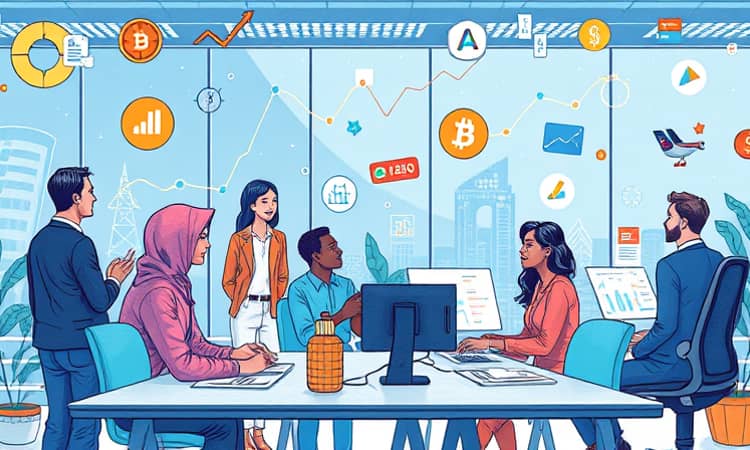
In an era defined by economic uncertainty, rapid technological change, and shifting workforce dynamics, the conversation around work has fundamentally become a financial narrative. Companies and individuals alike face the task of aligning resources, skills, and aspirations with evolving market realities.
Macro Context: The Financial Imperative of Work Evolution
Organizations today are navigating a low-growth, low-rate environment that mandates tightening control of workforce costs. Central banks in Europe and the UK are poised to cut rates aggressively, squeezing profit margins and compelling firms to optimize headcount and performance.
According to industry forecasts, financial-sector leaders anticipate an extended period of margin compression. With central banks cutting rates aggressively in 2025, banks and insurers will tighten staffing budgets, making strategic workforce planning and automation investments non-negotiable.
At the same time, demographic trends and talent shortages amplify the stakes. With ageing populations and a rising demand for digital expertise, employers confront a dual challenge: securing scarce skills while managing finite budgets.
- Interest-rate shifts reshape labor-cost forecasting.
- Ageing demographics limit workforce supply.
- AI adoption drives productivity aspirations.
- Financial strain undermines employee engagement.
Engagement, Retention, and the ‘Quit and Stay’ Phenomenon
Amid global talent shortages, many employees remain in their roles for security, yet contribute far below potential. This ‘quit and stay’ trend masks a quiet disengagement and hidden liabilities for corporate balance sheets.
The cost of replacing a single skilled employee can reach 150% of annual salary when accounting for recruitment, onboarding, and lost institutional knowledge. Consequently, investment in retention strategies often yields a stronger return than chasing external hires.
As turnover costs rise, organizations must invest in compensation, development, and culture to foster loyalty. Research shows that when leaders create supportive environments, workers are more likely to stay engaged—even if they never step foot in an office.
Remote, Hybrid, and the ‘Infinite Workday’
The traditional nine-to-five model has effectively vanished. Advanced connectivity means that 38% of employees willingly extend their availability beyond core hours, resulting in an infinite workday that blurs personal and professional boundaries.
Offering flexible remote and hybrid options has become non-negotiable for top talent. Firms leveraging global distributed teams can maintain around-the-clock operations, but must navigate complex payroll, tax, and compliance landscapes.
Yet the global reach of hybrid teams amplifies risk. Firms must adapt payroll, benefits, and tax systems to local regulations, forcing a reevaluation of traditional HR practices and partnerships.
Well-being, Burnout, and Hidden Balance-Sheet Liabilities
By 2025, stress and burnout levels are expected to converge across all work settings—remote, hybrid, and onsite. Economic uncertainty, increased workloads, and relentless pace of change drive a surge in anxiety that erodes productivity and morale.
Without robust support, escalating anxiety can lead to chronic absenteeism and increased healthcare costs, representing a significant hidden expense for employers.
Organizations ignoring mental health risk a worsening of employee retention and performance metrics. Supporting well-being is no longer a perk but a strategic imperative tied directly to the bottom line.
Compensation and Benefits: Transparency, Skills, and Personalization
The compensation landscape is shifting toward more transparent, equitable, and flexible pay structures. Companies are publishing salary ranges, auditing pay gaps, and investing in underrepresented talent to meet regulatory and ethical demands.
While pay adjustments to close equity gaps may entail short-term cost increases, companies reap long-term dividends in attraction, reduced litigation risk, and enhanced brand reputation among both talent and investors.
A parallel transformation links pay to capabilities. With AI skills commanding an average 56% wage premium, businesses face the choice: pay up for scarce expertise or build capacity in-house through reskilling. The latter offers lifelong learning and market alignment but requires upfront investment.
Beyond salary, benefits are evolving into curated total rewards packages that recognize diverse needs. Key components include:
- Flexible work arrangements tailored to roles and lifestyles.
- Comprehensive mental health and stress management services.
- Family-friendly policies such as childcare assistance.
- Financial wellbeing programs, including low-interest payroll loans.
Employee Financial Wellness: Personal Finances as a Business Priority
With 55% of workers under financial strain, companies are realizing that personal finances influence engagement, trust, and openness to change. Employees struggling to pay bills are less motivated and less likely to embrace new initiatives.
Data shows that each dollar invested in employee financial wellness returns up to $2.30 in productivity gains, underscoring a compelling business case for comprehensive programs.
Forward-thinking organizations are embedding tailored financial support mechanisms into their offerings. By linking individual goals with corporate objectives—especially around AI adoption—they cultivate a workforce primed for transformation.
- Educational resources on budgeting and debt management.
- Short-term, low-interest loans to avoid predatory alternatives.
- Personalized coaching for groups with unique financial burdens.
- Incentive plans aligned with skill development and company goals.
Charting a Sustainable Path Forward
The intersection of economic forces, technology, and human capital defines the next chapter of work. To thrive, leaders must balance cost control with strategic investment in skills, culture, and wellbeing.
Embracing this integrated approach promises not only financial stability but also shared success and resilience for organizations and their people.