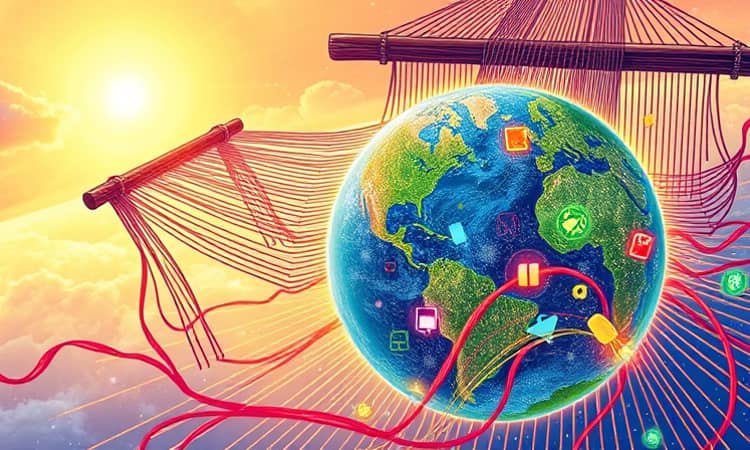
Envision the world economy as a vast, intricate fabric woven from threads of trade, innovation, and human aspiration.
This financial tapestry is dynamic, constantly reshaped by global trends and local decisions.
As we approach 2026, the imperative is to strengthen this weave against fraying edges and integrate new strands of opportunity.
Forecasts hint at a global growth rate of 2.4% to 2.8%, a slight moderation from prior years.
Yet, within this broad picture, vibrant patches of resilience and potential emerge.
Building a robust economic future demands understanding these patterns and acting with purpose.
Global Economic Outlook: A Tapestry of Forecasts
Projections for 2026 reveal a nuanced but hopeful landscape.
Consensus centers on 2.4-2.8% global growth, fueled by policy easing and consumer confidence.
However, risks like tariffs and debt loom as potential disruptors.
To grasp the full picture, consider the detailed regional forecasts below.
This table underscores the diverse threads of economic performance across the globe.
Each region contributes uniquely, highlighting the need for interconnected strength and collaboration.
Weaving Positive Threads: Key Growth Drivers
Several forces are set to bolster the economic fabric in coming years.
Consumer spending stands as a primary driver of expansion.
- US consumer confidence rebound across income brackets.
- Eurozone labor market strength with unemployment at 6.3%.
- India's private consumption growing at 7.5%.
- Global private demand fueling sustained growth.
Investment and capital expenditure are equally critical.
They provide the backbone for long-term prosperity.
- US AI and business momentum driving private investment.
- India's gross fixed capital formation at 7.6%.
- Eurozone's modest investment rebound contributing 0.3% to GDP.
- Nearshoring benefits in Mexico and other regions.
Policy support offers a sturdy framework for growth.
Fiscal stimulus from US midterms, Germany, and China injects vitality.
Monetary easing with Fed cuts aids global liquidity and recovery.
Reforms in Argentina foster stability and attract foreign inflows of $54.1B.
Sectoral advancements add vibrant colors to the tapestry.
- Energy and mining booms in Argentina.
- Services, tourism, and metals in Colombia with significant inflows.
- Manufacturing growth in India at 9.1%.
- AI and semiconductors transforming Asia's economic landscape.
Market performance, while concentrated, presents opportunities.
The S&P 500 versus Magnificent 7 returns highlight tech sector dynamics.
Addressing Frays in the Fabric: Major Risks
Despite optimism, several threats could weaken the economic weave.
US tariffs pose a significant drag on exports for many economies.
- Impact on India, Mexico, eurozone, and China.
- USMCA review in July 2026 adding uncertainty.
- Front-loading effects that may unwind over time.
Debt and investment constraints are pervasive challenges.
High debt burdens limit fiscal space in regions like the US.
Overextended public budgets hinder sustainable development efforts.
Inflation and geopolitical risks add pressure to the fabric.
- Edge-up inflation in US and China.
- Slow inflation in eurozone, UK, and Japan.
- Ongoing tensions creating financial instability globally.
Other specific issues include China's property downturn.
Commodity volatility in Colombia affects oil-dependent economies.
Political uncertainty in the eurozone, with savings rates around 19%.
Labor market challenges, such as Colombia's 8.8% unemployment, strain growth.
Fragmentation risks persist with K-shaped recovery gaps closing slowly.
Policy Threads: Monetary and Fiscal Outlook
Effective policies are essential to mend and strengthen the fabric.
An easing trend in monetary policy is underway globally.
Fed cuts are expected to broaden US economic recovery.
A new Chair in May 2026 may lean pro-growth, enhancing support.
Global central bank actions will aid liquidity and stability.
In Colombia, inflation is projected to drop to 3.7%.
Peso stability around 4,000/USD fosters confidence.
Fiscal expansion is needed to offset external shortfalls.
Stimulus measures in the US, Europe, and Asia inject vitality.
Currency dynamics, such as USD depreciation, influence trade patterns.
A stronger RMB may aid China's rebalancing efforts.
Regional Narratives: Anchors and Diversifiers
Different regions play unique roles in the global economy.
The US acts as an anchor, with outperformance driven by AI.
No recession is anticipated despite soft job markets.
This showcases remarkable resilience and adaptability.
Emerging economies like India, Argentina, and Colombia lead diversification.
Their tariff-resilient nature makes them crucial threads in the fabric.
India's consumption and investment trends set a positive example.
Argentina's reforms attract foreign inflows, boosting growth.
Colombia's services and tourism sectors thrive with coffee and metals.
China and Europe are in transition, rebalancing towards domestic demand.
Fiscal help is available, but tariffs and consolidation pose headwinds.
Globally, resilience exceeds expectations with a 3% cycle speed.
AI is transformative, driving innovation amid policy evolution.
Practical Weaving: Steps for a Stronger Future
To contribute to this economic fabric, take actionable steps today.
Diversify investments across regions and sectors to mitigate risks.
Embrace technological advancements, especially in AI and digital services.
Support policies that foster innovation and fair trade practices.
Focus on sustainable practices to ensure long-term growth.
- Engage in continuous learning to adapt to economic changes.
- Build networks that enhance cross-border collaboration.
- Advocate for reforms that reduce debt and inflation pressures.
- Invest in sectors with high growth potential like renewable energy.
- Promote consumer confidence through community-driven initiatives.
By understanding the threads and patterns, we can all participate.
The financial fabric is not static; it is a living entity we shape.
With strategic foresight and collective effort, we ensure robustness.
Weave in compassion and equity to create a future that benefits all.
Let this tapestry of growth inspire action and hope in every thread.