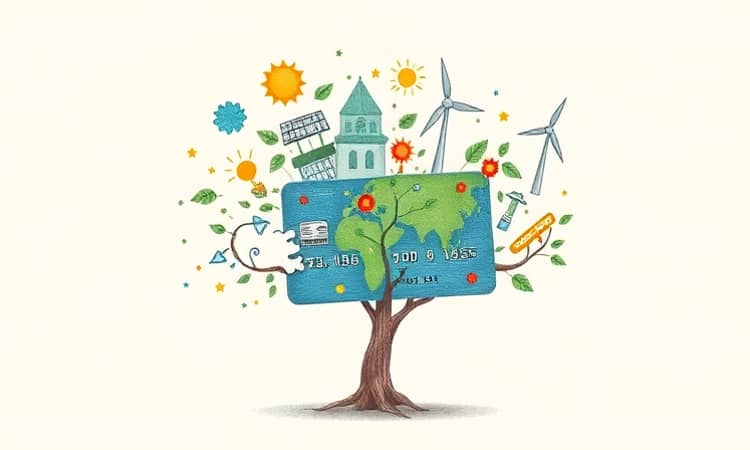
Every time you reach for your wallet, a small piece of plastic might be quietly harming our planet.
Credit cards symbolize convenience and modern finance, yet their environmental toll is vast and often overlooked.
The primary material, non-recyclable PVC from petroleum, starts a chain of ecological damage that extends globally.
This article uncovers the full lifecycle impact of credit cards, from toxic production to carbon-heavy transactions.
By understanding these effects, you can empower yourself to drive positive change through smarter choices.
Plastic Production and Material Impacts
Most credit cards are made from polyvinyl chloride or PVC, a material derived from fossil fuels.
Its production involves energy-intensive extraction and toxic chemicals, contributing to pollution and climate change.
PVC is notoriously difficult to recycle, leading to waste that persists in landfills for centuries.
The global scale is staggering, with billions of cards in circulation exacerbating these issues.
- Petroleum-based origins deplete natural resources.
- Release of harmful substances like phthalates during manufacturing.
- Low recyclability rates increase plastic pollution.
- Frequent card replacements every 3-4 years add to e-waste from chips and magnetic strips.
Switching to alternative materials could reduce the carbon footprint by 30-75%, highlighting a path forward.
Emissions from Card Manufacturing
Producing credit cards emits significant greenhouse gases, primarily carbon dioxide equivalent or CO2e.
In 2021, global cards in circulation reached 17.2 billion, mostly made from PVC.
This production alone emitted approximately 293,525 metric tons of CO2e, using standard emission factors.
To put this in perspective, it is equivalent to driving a diesel car around the Earth 43,000 times.
The United States issues over 3 billion new cards yearly, enough to wrap around the planet more than six times.
- Emissions from raw material extraction and processing.
- Energy use in manufacturing facilities.
- Transportation logistics for card distribution.
- Potential savings with eco-friendly materials like recycled or bio-based plastics.
These numbers underscore the urgent need for innovation in card production methods.
Transaction Emissions and Process Inefficiencies
Beyond production, each card transaction contributes to carbon emissions through a multi-step process.
In 2021, global card transactions totaled 787 billion, emitting 416,742 metric tons of CO2e.
Direct bank payments, such as Automated Clearing House or ACH transfers, could reduce this by 75% to 104,222 metric tons.
Per transaction, a card payment emits about 0.53 grams of CO2e across eight steps, while ACH uses only 0.13 grams in two steps.
This inefficiency highlights how simple shifts in payment methods can yield substantial environmental benefits.
- Steps include authorization, clearing, and settlement across networks.
- Data centers and terminals consume electricity, adding to Scope 2 emissions.
- Debit cards have a lower impact than credit cards due to fewer billing steps.
- Digital wallets like Apple Pay further reduce energy use by minimizing physical card reliance.
Every transaction is a small but cumulative contribution to your carbon footprint.
Corporate Emissions from Major Networks
Major payment networks like Visa and Mastercard have significant operational footprints, divided into Scope 1, 2, and 3 emissions.
Scope 1 and 2 cover direct and indirect emissions from operations, while Scope 3 includes supply chain impacts.
Visa reported Scope 1+2 emissions of 10,600 metric tons of CO2e in 2023, with Scope 3 at 409,500 metric tons.
Mastercard's total emissions were 557,545 metric tons, with Scope 1+2 at 52,054 and Scope 3 at 437,588 metric tons.
Both companies have pledged net-zero emissions by 2040 and use offsets and renewable energy to mitigate impacts.
- Visa achieved carbon-neutral operations since 2020, offsetting 66,300 metric tons of CO2e.
- Mastercard reduced Scope 1+2 emissions by 7% year-over-year and aims for a 38% reduction by 2025.
- Supply chain emissions dominate Scope 3, highlighting the need for vendor sustainability.
- Investments in ESG products, such as Mastercard's $500 million initiative, drive industry-wide change.
These efforts show corporate responsibility but also reveal the scale of the challenge.
Full Lifecycle Assessment
The environmental impact of credit cards extends beyond production and transactions to include terminals, data centers, and disposal.
Terminals account for about 75% of the total lifecycle impact, due to rare earth metals and energy consumption.
Data centers powering payment networks require substantial electricity, often from non-renewable sources.
Chips and magnetic strips add to e-waste, as they are hard to recycle and contain toxic materials.
Transportation of cards and equipment across the globe further increases the carbon footprint.
Disposal poses risks, with PVC degrading into microplastics that humans ingest, equivalent to a credit card's weight per week.
- Lifecycle stages: raw material extraction, manufacturing, distribution, use, and end-of-life.
- SoftPOS solutions on mobile devices can reduce terminal impact by up to 50%.
- Fraud prevention via chip technology offsets some environmental costs by reducing financial waste.
- Digital banking energy use is growing, but efficiencies in cloud computing offer savings.
A holistic view is essential for addressing all environmental facets.
Sustainable Alternatives and Innovations
Innovative solutions are emerging to mitigate the environmental impact of credit cards.
Eco-cards made from recycled or biodegradable materials are gaining traction, with lower carbon footprints.
Examples include cards using ocean plastic, corn-based bioplastics, and sustainable inks like air ink from pollution.
Carbon-limited cards, such as the DO card, track CO2 per purchase and block transactions at a set maximum.
Digital tools like Mastercard's Carbon Calculator, available in over 50 banks, help consumers monitor their footprint.
- Local production reduces transportation emissions.
- Carbon offset programs, like those from Ben & Jerry’s, neutralize emissions from purchases.
- Digital wallets eliminate the need for physical cards, cutting material use and energy.
- Consumer demand is rising, with 67% supporting carbon labeling on products.
These alternatives empower you to make greener financial decisions effortlessly.
Equivalents for Readability
Translating emissions into relatable units makes the impact more tangible and inspires action.
The CO2e from card production is equivalent to 90,000 round-trip economy flights from New York to San Francisco.
A single debit transaction's lifecycle impact equals 90 minutes of an 8-watt low-energy lightbulb.
Compared to cash, which has five times the impact of a debit card, cards offer some efficiency.
- Driving a car for 10 miles equals the emissions from about 20 card transactions.
- One year of card use per person might equal the CO2 from charging a smartphone for months.
- Industry-wide, the savings from switching to ACH could power thousands of homes annually.
- Visualizing these equivalents helps bridge the gap between abstract data and daily life.
This approach fosters a deeper connection to environmental stewardship.
Industry-Wide Scale and Consumer Sentiment
The banking sector's contribution to emissions is substantial, driven by high card issuance volumes.
In the US, over 3 billion new cards are issued yearly, reflecting a culture of frequent replacement.
Consumer sentiment is shifting, with 64% viewing brands positively that adopt sustainable practices.
Two-thirds of consumers expect banks to take environmental action, creating pressure for change.
Banks can gain business by offering eco-cards, as demand for green products grows.
- Global trends show increasing adoption of digital payments, reducing physical card reliance.
- Regulatory pressures may soon mandate lower emissions in financial products.
- Educational campaigns on the environmental cost of cards can drive consumer awareness.
- Collaborations between banks and eco-initiatives, like the Aland Index for carbon tracking, are expanding.
Your choices as a consumer can catalyze industry-wide transformations toward sustainability.
By opting for eco-cards, using direct bank transfers, and supporting innovative tools, you reduce your carbon footprint.
Every swipe is an opportunity to vote for a greener future, making financial decisions that align with planetary health.
Start today by exploring alternatives and demanding transparency from your financial institutions.