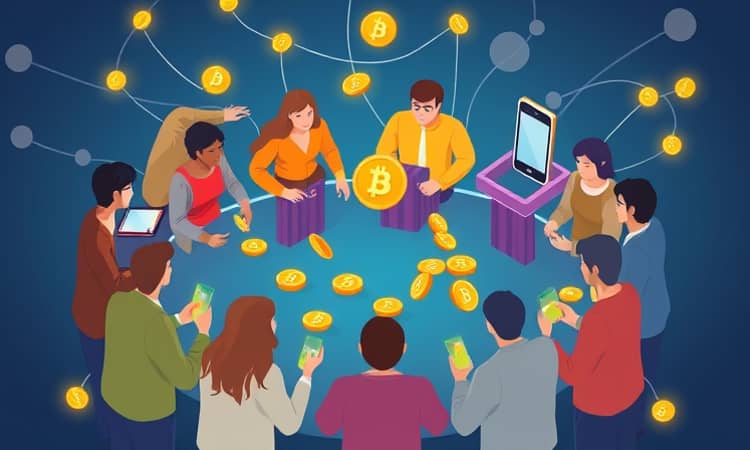
Imagine a world where your financial dreams are not held back by traditional banking barriers. Peer-to-peer lending is transforming how we access and provide credit, creating a truly democratized financial landscape that empowers everyday people.
This innovative model bypasses banks to connect borrowers directly with investors, offering a more personal and efficient way to manage money. It's built on the principle of community-powered support and trust, reshaping the very foundations of lending.
With projections showing explosive growth, P2P lending is not just a trend but a sustainable shift towards inclusive finance. By tapping into this system, you can be part of a movement that values accessibility and mutual benefit over corporate control.
The Remarkable Growth of P2P Lending
The global P2P lending market is expanding at an unprecedented rate. In 2025, it reached a valuation of USD 226.34 billion, and it's projected to soar to USD 1,837.91 billion by 2035.
This growth is driven by a compound annual growth rate (CAGR) of 23.3% from 2026 to 2035. Some forecasts even suggest higher rates, highlighting the immense potential of this sector.
- Current market size: USD 226.34 billion in 2025.
- Projected to reach USD 279.07 billion in 2026.
- Expected to hit USD 1,837.91 billion by 2035.
Regional dominance shows North America leading with over 40% of the market share. Key markets include China, the US, Australia, Canada, and the UK, indicating widespread adoption.
- North America: USD 83.29 billion in 2025, projected to reach USD 676.35 billion by 2035.
- Other leading regions: China, US, Australia, Canada, UK.
What Exactly is Peer-to-Peer Lending?
P2P lending is a financial model that connects borrowers directly with investors through online platforms. It eliminates traditional intermediaries like banks, allowing for more direct and transparent transactions.
This approach was founded in the mid-2000s and has since evolved to offer minimal intermediation and faster speeds. It's ideal for individuals and small businesses seeking loans without the hurdles of conventional institutions.
- Connects borrowers and investors directly.
- Facilitates loans without traditional banks.
- Offers broader accessibility to credit.
Benefits for Borrowers and Lenders
For borrowers, P2P lending provides competitive interest rates and lower costs. It also ensures faster loan approvals and greater flexibility in repayment terms, making it a lifeline for those excluded from traditional banking.
Freelancers and people with unconventional credit profiles can find opportunities here. This model promotes greater financial inclusion and democratized lending, breaking down long-standing barriers.
- For borrowers: Faster approvals, flexible repayment, access for underserved groups.
- For lenders: Higher returns compared to savings accounts.
Investors benefit from the ability to earn interest by directly funding borrowers. This offers better returns than conventional accounts and a chance to support community growth.
- Opportunity to earn interest on loans.
- Bypasses traditional banks for better rates.
- Supports a diverse range of borrowers.
P2P vs. Traditional Banking: A Comparative Analysis
Understanding the differences between P2P lending and traditional banking is key to making informed financial decisions. While banks offer stability, P2P provides agility and inclusivity.
Banks have advantages like deposit insurance and comprehensive services. However, they often come with lengthy processes and higher fees. P2P lending addresses these drawbacks by focusing on efficiency and community support.
Market Segmentation and Key Trends
The P2P lending market is diverse, with segments including consumer credit, small business loans, student loans, and real estate loans. In 2025, personal loans dominated with 69.80% of the market.
- Consumer credit loans: Significant growth segment.
- Small business loans: 30.20% of the market in 2025.
- Business models: Traditional platforms and marketplace models.
Growth is fueled by increasing demand for alternative financing and technological advancements. The rise of digital startups and e-commerce creates a constant need for flexible funding solutions.
- Growth factors: Technological innovations, digital adoption.
- Trends: AI transforming risk assessment, automated processes.
Safety, Regulation, and Consumer Adoption
Safety is a common concern, but trusted P2P platforms implement robust measures. They use identification checks and privacy protections similar to traditional lenders, ensuring secure and reliable transactions.
Regulation varies, with banks under strict oversight and P2P lending under moderate rules. This balance allows for innovation while maintaining consumer trust.
Consumer adoption is soaring, with 84% of people using P2P for cash transactions. Apps like Venmo have popularized this model, showing its integration into daily life.
Practical Steps to Get Involved
To start with P2P lending, research reputable platforms that align with your goals. Whether you're borrowing or investing, understanding the risks and rewards is crucial for success.
Diversify your investments to mitigate default risks. For borrowers, prepare a clear loan purpose to attract lenders. This proactive approach enhances your experience in this dynamic financial ecosystem.
- For lenders: Diversify across multiple loans.
- For borrowers: Present a compelling case.
- For all: Stay informed on platform policies.
Embrace technology like AI-driven tools for better decision-making. As Web 3 innovations emerge, P2P lending will continue to evolve, offering even more opportunities for community empowerment.
The Future of Community-Powered Finance
P2P lending is not just an alternative; it's a complement to traditional banking that fills critical gaps. With strategic partnerships forming, such as ING Bank and Funding Circle, its legitimacy is firmly established.
This model champions financial inclusion and technological disruption, paving the way for a more equitable world. By participating, you contribute to a system that values people over profits.
As we look ahead, the fusion of AI and community-driven principles will redefine finance. Peer-to-peer lending stands as a beacon of hope, proving that when we lend together, we grow together.