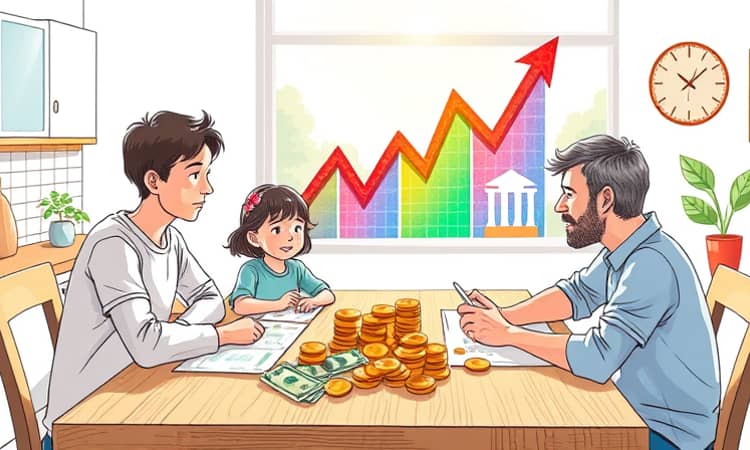
Inflation can feel like a silent companion, slowly diminishing the value of every dollar you earn and save. Yet, by understanding its mechanics and adopting proven strategies, you can protect your family’s financial future and even find opportunities amid rising prices.
In this article, we explore how inflation is measured, examine recent trends, consider its long-term impact, and offer practical tools to fortify your purchasing power.
Understanding Inflation and Its Measurement
At its core, inflation represents a sustained increase in the general price level and, equivalently, a decline in the purchasing power of money. Economists track these changes through price indexes, which gauge how costs evolve over time.
- Consumer Price Index (CPI-U): Monitors a “market basket” for urban consumers, weighted across food (14%), energy (8%), commodities (21%), and services (57%).
- Headline CPI vs. Core CPI: Headline includes all items; core excludes volatile food and energy to reveal underlying trends.
- Alternative metrics: Median CPI, trimmed-mean CPI, and Fed “Nowcasting” tools filter out extremes and offer real-time estimates.
By comparing headline and core rates, and reviewing expectations—roughly 3.2% over one year and 3.0% over three years as of 2025—you gain a nuanced view of inflation’s trajectory.
The Recent Inflation Landscape
For the 12 months ending September 2025, U.S. headline CPI rose 3.0%, matching core inflation. Monthly, prices climbed 0.3%, with food up 0.25% and energy surging 1.51%.
Major drivers include:
- Energy prices up 2.8% year-on-year, led by fuel oil (+4.1%) and a moderation in natural gas gains.
- Shelter costs remain elevated, reflecting tight rental markets and rising mortgage rates.
- Services beyond housing—healthcare, transportation—continue to contribute meaningfully due to their weight in the CPI basket.
Since peaking near 9% in 2022, inflation has cooled toward 3%, with markets forecasting a gradual descent to the Fed’s 2.5% target range by 2027.
A Century of Prices: Historical Perspective
Examining data back to 1913 reveals dramatic shifts: a dollar in 1913 bought what about $30 today can purchase. Between 1982–84 (CPI=100) and 2020 (CPI≈259), prices more than doubled, and are projected to reach 326 by 2027.
As a rule of thumb, at 3% inflation, cash loses about 3% of its real value annually if it earns no interest. Over a decade, that equates to more than a quarter of purchasing power evaporated.
The Real Impact on Families and Investors
Rising costs bite hardest at essentials: food, shelter, insurance, and healthcare. Lower-income households, spending a larger share on necessities, feel the squeeze more acutely.
- Fixed-income earners—pensioners, annuity holders—face shrinking real payouts when incomes lack inflation adjustments.
- Borrowers with fixed-rate loans benefit, repaying debts with “cheaper” dollars over time.
For investors, the inflation surge of 2022–23 broke the traditional 60/40 equity-bond cushion, as both asset classes stumbled under rising rates and persistent inflation.
Many are now rebalancing toward assets that offer explicit inflation protection or yield buffers against price rises.
Strategies to Shield Your Wealth
Building resilience starts with diversification and a focus on instruments linked to inflation. Below are key tools to consider as part of a holistic plan.
- Treasury Inflation-Protected Securities (TIPS): U.S. government bonds whose principal is indexed to CPI and pay interest on the adjusted balance. They carry low credit risk and can be held via TreasuryDirect or ETFs. While not a perfect short-term hedge against inflation, they excel as a long-run inflation protector than short-term trade.
- Series I Savings Bonds: These bonds combine a fixed rate and inflation-adjusted rate reset biannually. Backed by the Treasury and offering tax-deferred growth, they’re ideal for long-term savers up to $10,000 per person annually.
- Real assets: Commodities like gold, energy, and agricultural goods often move with price levels, while real estate and infrastructure can generate rental income that adjusts over time.
Beyond asset selection, consider these behavioral steps:
- Automate contributions to inflation-linked vehicles to avoid market timing.
- Review and adjust your budget periodically to align with changing price dynamics.
- Maintain an emergency fund in liquid, relatively inflation-resistant instruments to guard against unexpected shocks.
By embedding these strategies into your financial routine, you turn inflation from a stealth eroder into a manageable force. Educated planning, diversified allocations, and disciplined saving can preserve—and even enhance—your real wealth.
Inflation may cast a long shadow, but with the right tools and mindset, you can step into the light of financial security and thrive regardless of price pressures.