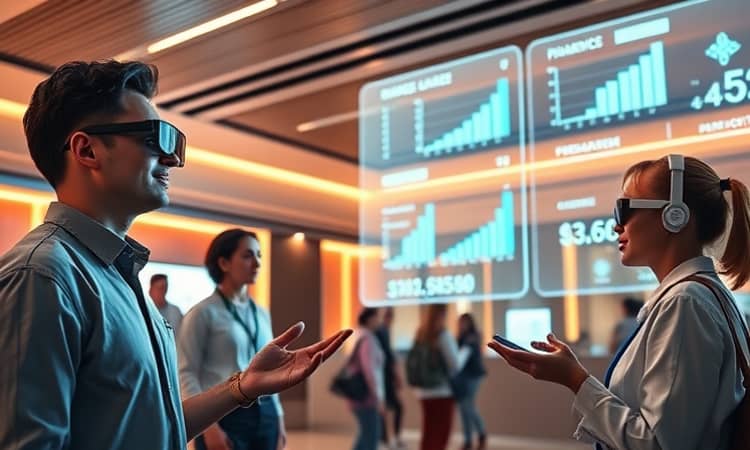
Imagine stepping into your bank without ever leaving your living room. Through virtual and augmented reality, financial institutions are redefining engagement, transforming mundane transactions into dynamic, interactive customer journeys. As this technology matures, both consumers and employees stand to benefit from enriched experiences that blend the physical and digital worlds.
Market Growth and Future Projections
The global AR segment in banking, financial services, and insurance reached approximately USD 994.6 million in 2023. Fueled by rapid innovation and increasing consumer curiosity, analysts forecast a compound annual growth rate of 24.6% through 2030, driving the market close to USD 4,637 million.
Beyond BFSI, the combined AR/VR market in finance is projected to surge from USD 40.62 billion in 2025 to an estimated USD 138.60 billion by 2032. User adoption mirrors this expansion: penetration of immersive technologies is expected to climb from 54.9% in 2026 to 57.0% by 2030.
Real-World Implementations Transforming Banking
Industry leaders are already harnessing VR and AR to elevate services and streamline operations. Bank of America pioneered virtual reality training for its employees across more than 4,300 centers, using realistic scenarios to strengthen communication and empathy skills. Real-time analytics track progress and guide targeted coaching.
- BNP Paribas: A VR app for retail customers to explore account activity and transactions in a virtual environment.
- Bank of Kuwait: VR-assisted branch design, optimizing layouts before construction.
- Citi: Holographic trading desks that enable immersive collaboration on financial markets.
- Kookmin Bank: A metaverse virtual town where avatars consult with bankers face-to-face.
- Westpac: Smartphone AR visualizations of balances and budgets in 3D bar charts.
- PrivatBank: Fully virtual banking processes secured with multifactor authentication in AR.
- Axis Bank: Iris-scan AR transactions for rural populations using Aadhaar integration.
- Visa Europe & Blippar: Point-and-pay AR payments by aiming smartphones at products.
Key Use Cases for VR/AR in Banking
Immersive technologies unlock fresh possibilities for customer engagement and internal operations. By converting static data into dynamic presentations, institutions can foster deeper understanding and quicker decision-making.
Key customer-facing and operational applications include:
Virtual Branch Experiences: Clients navigate lifelike branches from home, consulting advisors and reviewing products in real time without travel.
AR Onboarding and Support: Interactive guides overlay step-by-step prompts on documents, reducing errors and branch visits.
3D Data Visualization: Portfolios appear as interactive 3D graphs, letting customers simulate investment changes and explore projected outcomes.
AR Payment Simplification: Customers point phones at QR codes or items, view amounts due, and confirm transactions via overlays, cutting friction from checkout.
Technology Integration Trends
The convergence of mixed reality and artificial intelligence is accelerating. By embedding AI into AR/VR interfaces, banks can deliver real-time recommendations based on risk tolerance and personalized financial advice. Predictive analytics monitor market shifts and customer goals, nudging users toward optimized strategies.
Virtual assistants—extensions of Erica, Eno, and NOMI—will soon inhabit immersive environments, guiding users through financial planning and offering voice-activated insights. This synergy of AI and MR positions institutions to anticipate needs before users articulate them.
Impact on Customers and Businesses
Immersive financial experiences deliver tangible benefits across the ecosystem. Customers gain deeper control and clarity, while banks unlock efficiency and innovation.
- Quicker onboarding with step-by-step AR guidance that simplifies complicated forms.
- Clearer insights through interactive 3D spending visualizations that reveal hidden trends.
- Remote access to advisors via lifelike virtual branches, eliminating geographic barriers.
- Enhanced engagement through immersive product demonstrations and tutorials, boosting financial literacy.
- Reduced costs by minimizing physical branches and in-person consultations.
- Improved employee performance via real-time analytics and targeted coaching.
- Efficient collaboration in trading and risk management with 3D data analysis environments.
- Enhanced security through biometric and multifactor authentication in AR.
As the metaverse evolves, financial institutions that embrace VR and AR will differentiate through superior customer experiences and streamlined operations. By investing in immersive technologies today, banks can cultivate trust, foster loyalty, and empower users to navigate their financial journeys with confidence.
The path forward is clear: pilot small-scale VR/AR projects, gather user feedback, and refine experiences. Collaborate with technology partners to customize solutions that reflect each institution’s brand and customer needs. With vision and dedication, the future of banking will be immersive, intuitive, and inclusive.