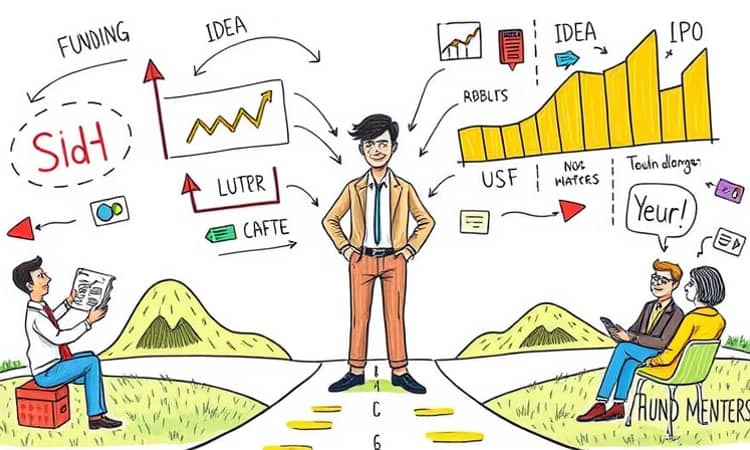
In the rapidly evolving world of startups, navigating funding from the first spark of an idea to a landmark liquidity event can feel like charting a course through uncharted waters. Success hinges on understanding each stage, aligning metrics with investor expectations, and choosing the right instruments at precisely the right moment.
Understanding the Startup Funding Landscape
In recent years, the United States has seen unprecedented investment activity. In November 2025 alone, investors poured $18.2B into 409 companies, marking a 49.2% increase over the previous month and a 56.9% year-over-year gain. Mega-rounds exceeding $500M were heavily concentrated in late-stage AI infrastructure and developer tools, highlighting the sector’s rapid ascent.
This environment can be both exhilarating and daunting. While capital pools have never been larger, competition is fierce. Founders must ground their ambitions in data, crafting a narrative that resonates with investors who seek proven traction and a path to real returns.
The Path from Idea to MVP
Every journey starts with an idea and often a lean form of funding. This earliest stage, sometimes called the concept or friends & family round, typically involves investments between $10K–$250K for product validation and market research.
Common sources at this stage include the founder’s own savings, close acquaintances, and angel investors willing to take a leap of faith. Instruments such as convertible notes or SAFEs provide a flexible bridge to future priced rounds.
- Validate the core problem and solution hypothesis
- Build a Minimum Viable Product to engage first users
- Capture feedback to refine the value proposition
Successful concept-stage founders focus on rapid iteration, demonstrating that their solution addresses a clear need.
Securing Pre-seed and Seed Capital
Once an MVP shows promise, the pre-seed round helps solidify product-market alignment. Typical round sizes range from $100K–$1M, sourced from angels, micro-funds, accelerators, and early-stage VCs. Investors at this juncture evaluate team strength, vision clarity, and early demos rather than revenue metrics.
As you progress to a formal seed round—often between $500K–$5M—expect increased scrutiny. Seed investors look for:
- Initial user traction: waitlists, pilot programs, or Letters of Intent
- A founding team with complementary skills
- A scalable go-to-market hypothesis
Preparation should include a light data room, clear cap table, and evidence of validated demand. While time horizons for returns can extend up to 10 years, early seed investment remains a critical leap of faith in your vision.
Scaling with Series A, B, and Beyond
With product-market fit established, Series A funding fuels growth. Rounds typically fall between $3M–$15M, though U.S. medians approach $18M. Investors in this stage expect solid monthly recurring revenue, user growth, and a repeatable customer acquisition model.
Key deployment areas include expanding sales and marketing teams, optimizing product features, and enhancing customer success functions. Transparent unit economics and clear paths to profitability become central to investor discussions.
Series B rounds, ranging from $15M–$50M+, accelerate market expansion. Growth-stage VCs, corporate venture arms, and growth equity funds seek strong revenue trajectories, strategic market entries, and operational excellence.
Beyond Series B, late-stage capital—Series C and onwards—drives high-volume expansion, strategic acquisitions, and IPO readiness. Rounds frequently exceed $50M, led by late-stage VC, private equity, and sovereign wealth funds.
Instruments and Innovative Financing Options
While equity rounds dominate headlines, a spectrum of instruments can optimize capital structure and minimize dilution.
- Convertible notes and SAFEs: dilution-delayed financing that converts at set triggers.
- Venture debt: extends runway without heavy equity loss, often paired with equity rounds.
- Revenue-based financing: repaid as a percentage of revenue, ideal for predictable cash flows.
- Grants and competitions: non-dilutive awards supporting early R&D.
Choosing the right mix can preserve ownership while fueling growth, especially when pricing risk or market volatility is high.
Key Metrics and Readiness Checklist
Investors evaluate readiness at each stage. Maintaining focus on these key financial readiness metrics helps ensure you meet or exceed expectations:
Ensure your pitch deck, financial model, and data room reflect these metrics accurately. Transparency builds trust and accelerates due diligence.
Navigating Liquidity Events
Reaching a liquidity event—whether an IPO, strategic acquisition, or secondary sale—transforms paper equity into tangible returns. Public offerings remain a staple for high-growth companies, though SPACs and large acquisitions also deliver significant outcomes.
Understanding the timing and structure of these events is critical for maximizing value for founders, employees, and early investors. Liquidity through strategic exits often requires rigorous governance, audited financials, and strong market positioning.
Embracing Diversity and Future Trends
Despite record capital flows, funding remains unevenly distributed. In 2024, just 2.3% of VC funding went to all-female founding teams, while over 83% went to all-male teams. Only 15.4% of VC partners are women.
By actively promoting diverse teams and inclusive cultures, startups unlock untapped innovation and access new markets. Investors are increasingly aware that diversity drives returns and resilience.
Looking forward, AI continues to dominate. In Q3 2025, 46% of global startup funding targeted AI companies, totaling $89.4B in 2025 alone. Founders who align with AI trends while maintaining strong fundamentals stand to capture the largest opportunities.
Conclusion: From Dreams to Realized Impact
The journey from concept to cash is a transformative process that tests vision, execution, and perseverance. By understanding each funding stage, choosing the right instruments, and aligning metrics with investor expectations, founders can confidently pursue growth.
Remember that capital is not an end in itself but a catalyst for building enduring value. With careful planning, transparent communication, and a commitment to diversity and innovation, your startup can turn an ambitious idea into a lasting legacy.