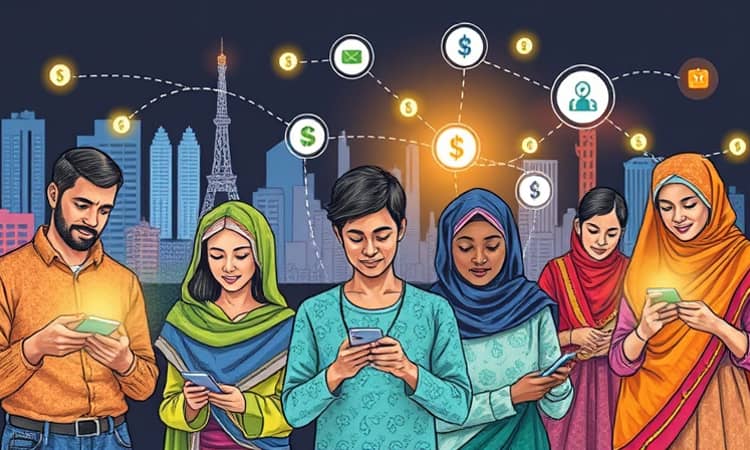
Financial inclusion through technology harnesses digital innovations to provide affordable, useful, and safe financial services to individuals and small businesses worldwide.
From remote villages to urban centers, digital tools are redefining access to payments, savings, credit, insurance, and investments.
Current Global State of Financial Inclusion
According to the World Bank, 79% of adults globally now have an account at a bank, financial institution, or mobile money provider—up from 51% in 2011 and 74% in 2021.
In low- and middle-income economies (LMICs), about 75% of adults hold accounts, reflecting an 80% increase since 2011. Despite these gains, 1.3 billion adults remain unbanked, with over half concentrated in eight countries: Bangladesh, China, Egypt, India, Indonesia, Mexico, Nigeria, and Pakistan.
Moreover, 1.6 billion people have no or inactive accounts, effectively excluding them from the digital economy.
Global digital payment usage has surged: 62% of adults made or received digital payments in 2024, a 28-percentage point increase over the past decade. In LMICs, 81% of account owners used digital payments, and 42% of adults made in-store or online purchases via card or mobile phone.
Formal saving in developing economies reached a decade high in 2024, with 40% of adults saving formally—an increase of 16 percentage points since 2021. Mobile money accounts are driving part of this trend, with 10% of adults in developing economies using them to save, up from 5% in 2021.
Mobile and connectivity remain key enablers: 86% of adults globally own a mobile phone, and more than half use their account via mobile phone or card, with 42% making digital payments for in-store or online purchases.
How Technology Is Driving Inclusion
Across the globe, digital innovations have expanded the reach of financial services. This section highlights key technological drivers revolutionizing access for millions.
Mobile money and digital wallets have been transformative, especially in the global south, where millions accessed their first financial services on phones with electronic value storage and digital channels through agent networks.
- Digital person-to-person (P2P) transfers
- Bill and merchant payments
- Cross-border remittances
- Basic savings and credit products
Digital lending built on mobile money histories has emerged as one of the fastest-growing trends in inclusive finance, bringing small loans to remote and underserved populations.
Real-time payment systems and interoperability, such as India’s UPI and Brazil’s PIX, enable instant, low-fee transactions at scale by providing public, low-cost digital rails that support QR and mobile-based merchant payments. These platforms allow fintechs to build additional services—lending, savings, insurance—on a modernized infrastructure.
World Bank and government initiatives are underway to modernize payment systems and remove regulatory roadblocks, further amplifying the impact of interoperable digital rails.
Digital identification and e-KYC simplify account opening and compliance by linking verifiable digital IDs with financial products. This foundation supports faster onboarding, reduced fraud, and scalable access to fintech services.
Government-to-person (G2P) payments through digital cash transfer systems are streamlining social protection. Direct deposits to accounts or mobile wallets reduce leakage, foster account usage, and generate transaction histories that underpin credit evaluations.
Finally, AI and data analytics are reshaping credit scoring by leveraging alternative data—transaction histories, mobile usage, utility payments—to underwrite small loans profitably. This paradigm shift moves the focus from having an account to nurturing ongoing financial health and resilience through personalized products and advice.
Inclusion Gaps and Who Is Left Behind
Despite rapid progress, significant segments remain underserved:
- Rural, hard-to-reach areas where infrastructure is limited
- Poor households lacking disposable income for fees
- Informal workers without formal documentation
Gender also influences access. Globally, 77% of women have accounts compared with 81% of men. In LMICs, women’s ownership rose from 37% in 2011 to 73% in 2024, yet gaps persist in smartphone ownership, autonomous usage, and credit access.
Connectivity issues compound these challenges: 16% of adults lack mobile phones, and many unbanked individuals cannot utilize digital services even if they own devices. Approximately 900 million unbanked adults own a basic mobile phone, and around 530 million have smartphones—revealing latent inclusion opportunities.
Low financial and digital literacy remain critical barriers. Complex regulations, high costs, and vulnerability to predatory lending and fraud disproportionately affect those with limited education and support.
Why Digital Financial Inclusion Matters
Broadening access to digital finance drives economic and social transformation:
- Economic opportunity and growth: Inclusion allows saving, investing, managing risk, and supporting entrepreneurship and job creation through transaction histories that lenders trust.
- Household resilience and formal saving: Formal savings via digital accounts help households survive shocks without resorting to high-cost debt.
- Operational efficiency and transparency: Digital G2P transfers reduce leakage, and merchant bill payments cut cash-handling risks.
- Women’s economic empowerment and inclusion: Ownership of private accounts and phones increases control over resources and decision-making power.
- Pathways to credit and insurance: Data from digital behaviors feed algorithms that underwrite nano-loans, working capital, and micro-insurance historically inaccessible to thin-file customers.
These benefits compound over time, creating virtuous cycles of investment, trust, and financial resilience for individuals and communities.
Key Technology Models and Examples
Concrete examples illustrate successful approaches to inclusive digital finance:
Mobile money ecosystems, as seen in parts of Africa and Asia, combine vast agent networks, wallet-to-bank interoperability, pay-as-you-go utilities (such as solar home systems), and cross-border remittances. They enable instant micro-loans and linked savings, demonstrating a holistic approach to inclusion.
National instant payment systems like UPI in India and PIX in Brazil showcase public infrastructure that drives innovation. UPI’s smartphone and USSD options support P2P and merchant payments via QR codes, empowering banks and fintechs to offer low-cost services on unified rails. PIX’s real-time transfers have become part of daily commerce, highlighting the scalability of interoperable systems.
Digital identity platforms—such as India’s Aadhaar system—coupled with e-KYC protocols, exemplify the fusion of ID and finance. By linking citizens to bank accounts and mobile wallets, these systems have facilitated mass G2P disbursements and accelerated private sector onboarding.
Emerging AI-driven credit scoring models leverage alternative data sources, such as social media, mobile transactions, and utility payments, enabling personalized underwriting for previously unbanked customers. This innovation holds promise for further closing the credit gap and tailoring financial health solutions at scale.
Together, these models provide a roadmap for policymakers, technology providers, and development partners to collaborate on inclusive digital finance solutions that leave no one behind.
Financial inclusion through technology is not merely a matter of infrastructure but a catalyst for dignity, opportunity, and resilience. By embracing digital tools, we can bridge the gap between aspiration and reality, crafting a future where everyone has the foundation to thrive.