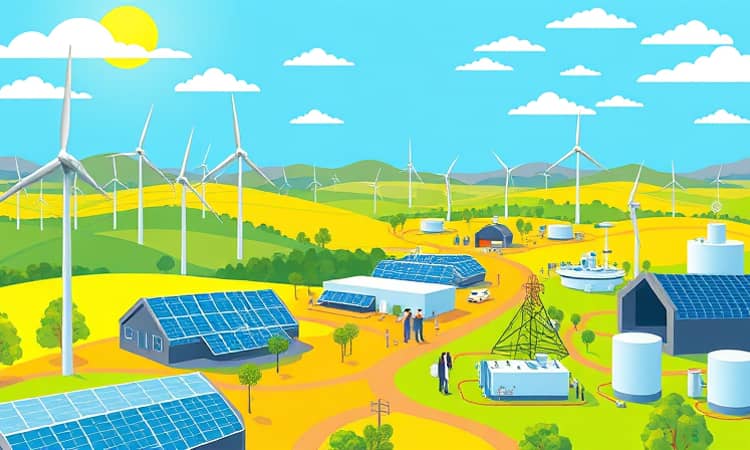
The global energy landscape is evolving at an unprecedented pace. As conventional power sources give way to renewable alternatives, investors, policymakers, and communities alike are navigating a complex web of opportunities and challenges. This article explores the trends, breakthroughs, and strategic decisions shaping the investment frontier in 2026.
From record-breaking capital flows to emerging technologies, the energy transition is not just an environmental imperative—it is a catalyst for economic transformation and technological innovation on every continent.
Investment Trends and Numbers
In the first half of 2025 alone, global clean energy investments hit records, totaling $386 billion—an increase of 10% year-on-year. By year-end, total clean energy deployment (renewables, storage, and grid enhancements) is expected to reach $2.2 trillion, effectively doubling fossil fuel expenditures.
Looking ahead, 2026 projections indicate renewables alone will command $780 billion in investment—outpacing oil by $245 billion. Cleantech spending is set to climb 30% over the next five years, with Asia and the Eastern Hemisphere capturing the lion’s share.
Capacity and Deployment Milestones
Renewables are no longer niche technologies. Global solar capacity surpassed 500 GW AC by end-2025, with China alone representing more than half of this total. Although additions in China may decline from 300 GW to 200 GW in 2026, the first YoY global decline of under 10% still reflects a robust pipeline.
Meanwhile, onshore wind capacity is poised to grow 45% to 732 GW by 2030, and offshore wind investment reached $39 billion in the first half of 2025. Combined solar and wind capacity is projected to hit 4,000 GW in 2026, comfortably eclipsing coal and gas operating capacity despite lower capacity factors.
Regional leaders are emerging as well. The MENA region saw a 44% increase in renewables capacity to 43.7 GW in 2025, with a pipeline of 202 GW waiting to come online. In the United States, solar and wind accounted for 87% of new power additions through October 2025.
Policy and Regional Dynamics
Policy frameworks around the world are both accelerating growth and introducing new complexities. In the U.S., the Inflation Reduction Act tax credits face a July 4, 2026 deadline, prompting developers to rush to meet eligibility requirements. Foreign ownership rules further complicate financing structures.
China’s mid-2025 shift toward competitive bidding slowed new solar capacity, but its 15th Five-Year Plan will target electrolyzers and green hydrogen at scale—growing from 1.5 GW in 2025 to 4.5 GW in 2026. Europe remains steady, driven by sustainable aviation fuel mandates and grid modernization efforts.
Emerging markets in Southeast Asia and Latin America are also gaining momentum, with combined renewables growth rates surpassing 7% annually. This global mosaic of policy creates pockets of rapid expansion—and pockets of uncertainty.
Emerging Technologies and Demand Drivers
As renewables dominate capacity additions, flexibility solutions become critical. Battery costs have fallen by more than half in two years, enabling data centers and AI hubs to test grid resilience. Global power sector investment in storage hit $66 billion in 2025.
Green hydrogen is moving from concept to reality. Electrolyzer capacity doubled global totals in 2025, with 10 GW now under construction. Sustainable aviation fuel capacity is also skyrocketing, up 33% to 8 million metric tons by 2026, and potentially reaching 42 million metric tons by 2030.
The AI revolution and electrification of transport are adding unprecedented demand pressures, but renewables are meeting these needs with unmatched cost competitiveness and scalability. The era of constant innovation and rapid deployment is here.
Challenges and Risks
Despite the promise, the transition carries risks. Supply chains remain vulnerable to geopolitical tensions and trade disputes, particularly where one nation dominates critical materials and manufacturing.
- Grid oversupply leads to curtailment and negative pricing in China, Spain, and Brazil.
- Policy reversals and uncertainty can cut projected capacity by up to 30%.
- Startups face capital scarcity amid shifting investor sentiment.
- Modernization lags in legacy grids, constraining integration of variable renewables.
Addressing these challenges requires coordinated policy action and strategic investments in transmission, storage, and digitalization.
Opportunities for Future Investments
For investors willing to embrace both risk and reward, the energy transition offers a wealth of opportunities:
- Scale projects in Asia and MENA, where pipelines exceed domestic capacity targets.
- Invest in long-duration storage and grid modernization to unlock value from variable generation.
- Support hydrogen and sustainable aviation fuel infrastructure, poised for explosive growth.
- Leverage corporate power purchase agreements and auction mechanisms for stable returns.
The principle of speed first, cost second, clean third is guiding many corporate and sovereign strategies, recognizing that accelerated deployment can lower long-term costs and reduce emissions most effectively.
Conclusion
As 2026 unfolds, the energy transition stands at a critical inflection point. Record-breaking investments, falling technology costs, and ambitious policy targets are reshaping the power sector. Yet challenges remain in financing, supply chains, and grid integration.
By understanding regional dynamics, embracing emerging technologies, and deploying capital strategically, stakeholders can ensure that the transition not only advances climate goals but also generates robust economic returns. The journey ahead will demand agility, collaboration, and unwavering commitment—but the reward is nothing less than a sustainable, prosperous energy future.