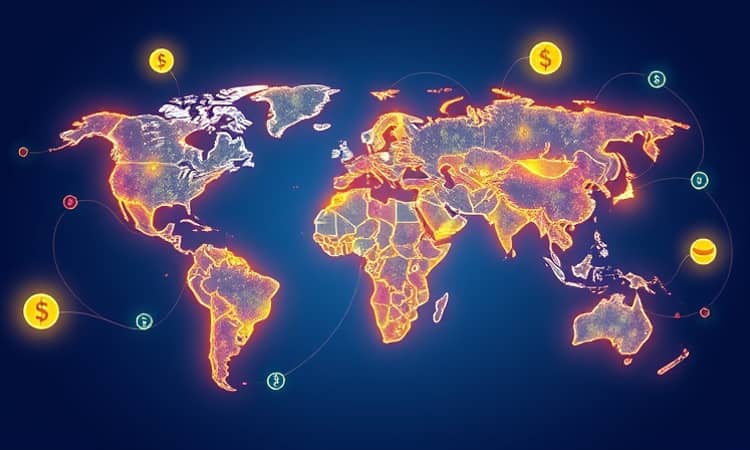
Global commerce, digital nomadism, and remote work have intertwined the world economy in unprecedented ways. Every day, billions of dollars cross borders for trade settlements, remittances, and digital purchases. For individuals waiting days for funds to clear, and for businesses grappling with hidden fees, the current landscape feels outdated and inefficient.
Yet, we stand at the cusp of a revolution. Fintech innovations, regulatory frameworks, and collaborative platforms are converging to reshape how value moves across continents. In this new paradigm, transactions can settle in seconds, fees become predictable, and every step is visible to end-users.
This article delves into the dynamic forces driving this transformation, focusing on three pillars—speed, cost, and transparency—that define the next generation of cross-border payments.
Market Explosion: A Quadrillion-Dollar Opportunity
The scale of global money movement is staggering: the combined traditional and crypto cross-border payments market approached $1 quadrillion in 2024. To contextualize, this amount dwarfs the GDP of every nation. Retail cross-border payments alone constituted roughly $200 trillion, and projections indicate a surge to $320 trillion by 2032. Underpinning this growth are rising international e-commerce volumes, dynamic remittance corridors, and expanding global supply chains.
Remittances—vital for millions of families—accounted for $905 billion in 2024. While digital wallets captured only $29 billion of this total, their rapid 33% growth highlights a shift toward surging digital wallet adoption rates. Simultaneously, cross-border bank credit expanded by $917 billion in Q2 2025, reflecting trust in international lending amid a 10% year-on-year increase. Yet consumer sentiment reveals a paradox: 771 million individuals engaged in cross-border transactions over a year, but only 16% feel satisfied with existing payment options, often citing delayed settlements, erratic charges, and lack of tracking.
The market’s trajectory underscores both opportunity and urgency. Stakeholders must harness this momentum to deliver tangible improvements, or risk eroding trust just as demand peaks.
- Market value in 2024: over $194.6 trillion
- Retail cross-border payments: projecting 9% CAGR
- 771 million consumers sending or receiving funds
- 30% make weekly cross-border e-commerce purchases
Regulatory Momentum: Aligning Policy with Progress
The G20’s 2020 Roadmap for Cross-Border Payments ushered in a new era of policy ambition. Financial leaders pledged to make transfers faster, cheaper, more transparent, and more inclusive. By 2021, global targets and quantitative KPIs galvanized efforts across jurisdictions. Yet, the FSB’s 2025 Consolidated Progress Report paints a nuanced picture: although foundational policies are largely in place, end-users have seen only incremental benefits.
Speed benchmarks for wholesale and retail transfers have improved, thanks in part to streamlined messaging standards. Access to basic payment services has grown, especially in underserved regions. However, average transaction costs remain “sticky,” hovering above desired thresholds in many corridors. Transparency enhancements—while notable in some high-income markets—have not reached a critical mass globally, leaving consumers in emerging economies without clear visibility of fees and processing stages.
With the 2027 deadline looming, the FSB plans to intensify monitoring, refine metrics, and support harmonized implementation. Success hinges on robust data sharing and monitoring, alignment of AML/CFT requirements, and deep cooperation between public authorities and private innovators.
- Broad access to payment services has expanded
- Wholesale payment speeds are improving globally
- Average costs remain sticky despite localized drops
- Data gaps hinder full transparency assessments
Accelerating Speed: Real-Time and Instant Payments
Historically, cross-border transactions required multiple correspondent banks, manual reconciliations, and cut-off times that delayed transfers by days. Today, the rise of real-time domestic systems is rewriting this narrative. Over 70 countries operate instant payment platforms, and users now expect similar performance in cross-border transfers.
- Pix processes thousands of transactions per second in Brazil
- UPI connects merchants, banks, and wallets in India
- TIPS supports multi-currency settlement across the Eurozone
Interlinking these networks presents both promise and complexity. G20 guidelines emphasize compatibility, AML/CFT compliance, and mutual scheme governance. By linking TIPS to other fast-payment rails, the ECB aims to optimize the messaging leg of transactions, yet the settlement leg still depends on correspondent relationships and liquidity pools. This dual structure underscores the need for a unified clearing mechanism and pre-funded accounts that can operate seamlessly across jurisdictions.
Amid these shifts, SWIFT gpi remains indispensable. It offers end-to-end tracking and fee transparency, and predictable delivery times, bridging legacy corridors and emergent instant networks. Together, these innovations chart a course toward truly frictionless global transfers.
Breaking Cost Barriers: From Sticky Fees to Local Currency Solutions
While speed advancements capture headlines, cost reductions have lagged. In many corridors, average retail transfer fees exceed 3%, a heavy burden for individuals and small businesses alike. For SMEs operating on narrow margins, high remittance fees and currency conversion charges erode profitability and restrict participation in global trade.
Regional disparities are stark. Transfers between developed economies often cost less than 1%, while corridors connecting low-income regions incur fees above 5%. To address this imbalance, payment providers are expanding local currency clearing networks in Latin America, Africa, and Southeast Asia. By settling in onshore currencies, these providers eliminate cross-border FX mark-ups and reduce reliance on costly correspondent banking pathways.
Trends in cost reduction include local currency settlements that minimize FX conversion fees, the rise of digital wallets offering lower-cost remittance channels, and the expansion of clearing networks in Latin America, Africa, and Southeast Asia. Ultimately, harmonizing cost and convenience demands strategic partnerships, shared liquidity pools, and scalable infrastructure. By prioritizing inclusive and affordable payment ecosystems, stakeholders can democratize access to affordable cross-border transfers.
Illuminating Transparency: End-to-End Visibility
Opaque pricing, hidden intermediaries, and fragmented messaging have long undermined confidence in cross-border payments. The lifeline of any transaction—visibility into fees, status updates, and expected delivery times—has been missing for too long. In response, stakeholders are embedding transparency as a core principle rather than a feature.
SWIFT gpi transforms the user experience by attaching a unique end-to-end tracking code to each payment. Senders can monitor progress through each bank in the chain, while receivers gain clarity on deductions. Parallel to this, the migration to ISO 20022 across major payment systems is enabling structured data exchange, richer remittance information, and enhanced screening capabilities that speed up compliance checks and reduce hold times.
Service providers now offer dashboards that break down costs by corridor, intermediary fees, and FX margins. Real-time notifications inform users of successful deliveries or exceptions, empowering proactive resolution. By making transparency an operational norm, the industry can meet evolving consumer expectations and foster a more resilient global payment ecosystem. The adoption of rich remittance information standards further reduces reconciliation friction.
Bridging Today and Tomorrow: Innovations on the Horizon
The transformation of cross-border payments is far from over. Central bank digital currencies (CBDCs) hold immense promise for settlement finality and compliance. Pilot initiatives in Asia are testing CBDC interoperability, enabling wholesale value exchange between central banks. In Europe, project mBridge explores multi-CBDC networks linking Hong Kong, Thailand, China, and the UAE, highlighting potential for secure, high-speed cross-border transactions without traditional intermediaries.
Blockchain and distributed ledger technologies continue to mature. Consortium models, such as the Utility Settlement Coin, aim to tokenize fiat currencies on a shared ledger, delivering secure high-speed cross-border value exchange and a unified source of truth.
Artificial intelligence and machine learning enhance every stage of the payment lifecycle. From fraud detection to liquidity forecasting, algorithms can parse vast data sets for anomalies, optimize payment routing, and predict corridor performance. Banks and fintechs are embedding these capabilities into portals, enabling smarter liquidity management and dynamic fee adjustments in real time.
Such innovations will require robust governance, standardized APIs, and clear regulatory frameworks. Collaboration among central banks, financial market infrastructures, and technology providers is essential to unlock the full potential of next-generation cross-border payment solutions.
The reinvention of cross-border payments is a multi-faceted journey. Market forces, regulatory mandates, and technological breakthroughs converge to redefine speed, cost, and transparency. While challenges remain—regulatory harmonization, infrastructure investment, and equitable access—the pathway is clear: embrace real-time rails, democratize fee structures, and illuminate every transaction with end-to-end visibility.
For businesses, this evolution unlocks new markets and fuels growth. For individuals, it offers reliable, affordable access to global funds. And for economies, it fosters deeper integration, resilience, and shared prosperity. As stakeholders unite to meet the 2027 G20 targets, the promise of seamless cross-border payments draws ever closer. The future of global money movement is not only faster and cheaper but also more transparent and inclusive, heralding a new age of interconnected finance.