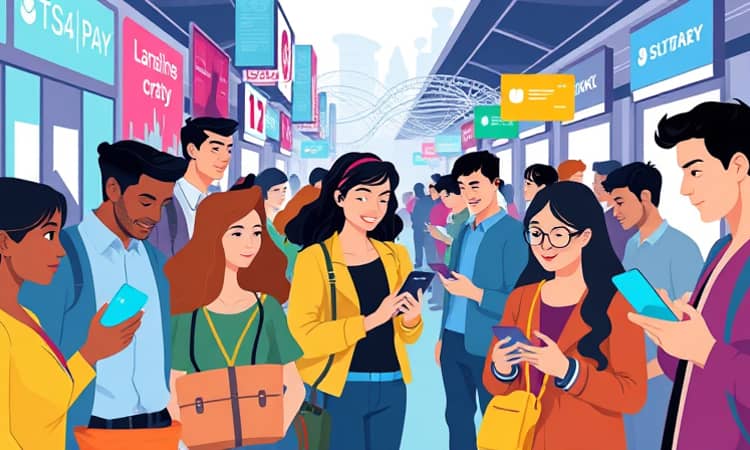
The financial landscape is transforming at a rapid pace, with contactless payments leading the charge toward a cashless society.
From the simple tap of a card to the seamless use of a smartphone, this technology is redefining convenience and efficiency in everyday transactions.
The global contactless payment market is projected to experience explosive growth, signaling a paradigm shift in how we interact with money.
This article explores the trends, benefits, and practical insights that make contactless payments the cornerstone of modern finance.
By understanding this evolution, you can harness its potential for personal and business success.
Market Growth and Projections
Contactless payments are not just a trend; they are a fundamental driver of the digital payments revolution.
The market is expected to surpass $12 trillion by 2027, growing at an annual rate of over 19%.
This growth is fueled by increasing consumer adoption and technological advancements.
Digital wallets, for instance, are set to dominate global ecommerce, capturing 65% of transactions by 2030.
To illustrate regional dynamics, consider the following table that highlights key metrics.
Asia-Pacific leads with 60% of global digital wallet users, showcasing rapid innovation.
These projections underscore the unstoppable momentum toward digital-first transactions.
Transaction Volume and Regional Statistics
Real-world data confirms the surge in contactless usage across the globe.
In the Euro area, card transactions increased by 10.3% in H1 2024, with contactless volume up 13.2%.
The US has seen a fivefold increase in tap-to-pay since 2020, with over 80% of consumers using contactless methods.
Key statistics highlight the widespread adoption.
- Euro area: 86% of POS terminals are contactless-enabled.
- US: 96.5% of merchants offer contactless payment options.
- Global: 42% of adults made digital merchant payments in 2024.
- Time savings: Consumers saved $19.3 billion annually from 2017-2021.
- London transit: Contactless journeys grew at a CAGR of 39.6%.
This data points to a fundamental shift in consumer behavior and infrastructure.
Key Trends Shaping 2026
As we look ahead, several trends will define the future of contactless payments.
These innovations are set to enhance speed, security, and accessibility for all users.
Here are the top trends to watch.
- Tap-to-Pay Revolution: Already dominates over 70% of card transactions globally.
- Digital Wallets: Expected to lead in ecommerce and point-of-sale by 2030.
- SoftPOS/Tap-to-Phone: Saw 44% adoption growth in 2024, empowering small merchants.
- Real-Time Settlement: Projected for a 30% global adoption increase by 2026.
- Biometric Authentication: Enhancing security with fingerprint and facial recognition.
- Voice-Based Payments: Emerging as a hands-free option for convenience.
- Account-to-Account Payments: Driven by open banking initiatives.
- Dynamic Platforms: Offering customized experiences for users.
These trends emphasize the move toward seamless and integrated financial ecosystems.
Drivers of Adoption
The rapid adoption of contactless payments is driven by multiple factors that benefit both consumers and businesses.
Understanding these can help you leverage the technology effectively.
Key drivers include:
- Consumer preference for speed and convenience over cash.
- Post-pandemic hygiene concerns, now sustained by data insights.
- Merchant benefits such as faster checkouts and reduced friction.
- Banks and fintechs using tokenized NFC and APIs for personalization.
- Improvements in card infrastructure and contactless technology spread.
These elements combine to create a compelling case for widespread use.
Benefits and Economic Impact
Contactless payments offer tangible advantages that translate into real-world savings and efficiency.
For consumers, the benefits are immediate and impactful.
Time savings alone amount to billions of dollars annually, as seen in global studies.
Merchants also gain significantly.
- Checkout speed increases by up to 40%, boosting customer satisfaction.
- Data collection enables better risk models and loyalty programs.
- Reduced cash handling lowers operational costs and security risks.
- Transit systems, like London's, have shifted from closed-loop to open-loop contactless.
- Economic impact includes billions saved in transaction costs globally.
These benefits make contactless payments a win-win for all stakeholders.
Challenges and Practical Solutions
Despite the advantages, challenges remain that users and businesses must navigate.
Addressing these can ensure a smoother transition to contactless methods.
Common issues include:
- Network connectivity problems affect 68% of users, causing transaction delays.
- Payment confirmation delays are reported by 26% of consumers.
- High rents for POS machines impact 5% of small merchants.
- Declining revenue from traditional high-fee methods due to low-fee digital options.
- Minor technical glitches, though rare, can disrupt user experience.
Solutions involve investing in robust infrastructure and user education.
By proactively tackling these hurdles, the adoption process becomes more resilient.
Future Outlook and Innovations
The future of contactless payments is bright, with continuous innovation on the horizon.
By 2030, digital wallets are expected to dominate both online and in-store transactions.
Key predictions for the coming years include:
- Near-universal adoption in retail, transport, and hospitality sectors.
- Expansion into healthcare, entertainment, and public services.
- Integration of real-time settlement systems like FedNow and SEPA Instant.
- Growth of embedded payments, projected to exceed $360 billion in revenue by 2027.
- Increased use of biometric and contactless methods for in-store streamlining.
This evolution promises a more connected and efficient financial world.
Conclusion
Contactless payments are more than a technological advancement; they are a gateway to a smarter financial future.
With projections showing massive market growth and trends emphasizing innovation, now is the time to embrace this shift.
By understanding the drivers, benefits, and challenges, you can position yourself for success in a digital-first economy.
Whether you are a consumer seeking convenience or a business aiming for efficiency, contactless payments offer practical solutions.
As we move toward 2026 and beyond, let this knowledge inspire you to tap into the potential of seamless transactions.
The journey toward a cashless world is accelerating, and with it comes endless opportunities for growth and connection.