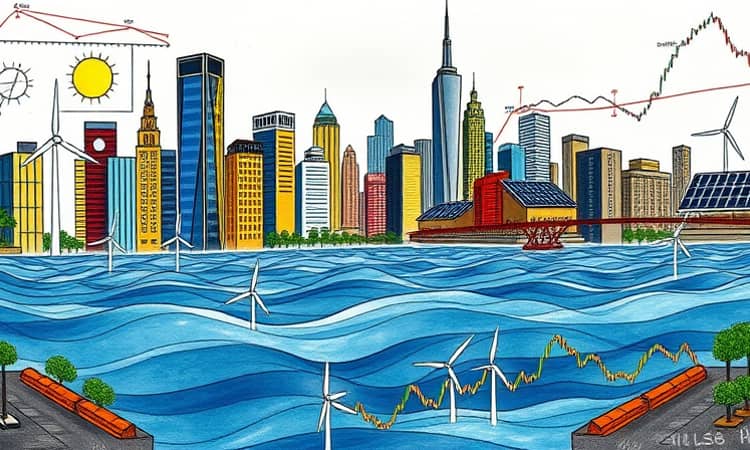
As climate risks intensify, they are reshaping the contours of global finance and corporate strategy. From acute physical shocks to policy-driven transition pressures, organizations face an evolving landscape that demands foresight and agility.
This article delves into the core climate risks, their profound financial impacts, and proven strategies to embed resilience and sustainable growth at the heart of decision-making.
Understanding Core Climate Risks
Climate hazards manifest in four interrelated categories, each carrying its own challenges for balance sheets and portfolios. Recognizing these distinctions empowers businesses and financial institutions to craft targeted responses.
Physical risks such as chronic coastal flooding have already erased over USD 15.8 billion of U.S. property value, with estimates rising to USD 560 billion by 2035. Meanwhile, transition risks loom as carbon prices in the EU surge toward EUR 108 per tonne, exposing energy-intensive firms to sharp repricing.
Mispricing persists due to data gaps, and only 4% of net-zero pledges currently meet stringent transparency standards. Liability losses, exemplified by sudden market value drops after wildfire disclosures, underscore the need for proactive legal risk assessments.
Financial Impacts on Institutions and Portfolios
Risks flow through credit, market, operational, and liquidity channels, eroding valuations and testing balance sheets. Unprepared institutions face elevated default rates, impaired cash flows, and regulatory penalties.
Key manifestations include:
- Asset repricing: Underinvestment in scenario analysis leaves equity valuations blind to future climate costs.
- Credit strain: Higher financed emissions baselines signal transition vulnerability across portfolios, triggering tighter lending standards.
- Operational disruptions: Supply chain interruptions compel companies to absorb unexpected CapEx, diminishing profit margins.
Emerging markets often bear disproportionate burdens, balancing food import dependencies and currency volatility. Meanwhile, regulators from the European Central Bank to the U.K. Prudential Regulation Authority mandate climate disclosures under TCFD and IFRS S2, raising the bar on transparency.
By 2026, physical risks are projected to be the most financially material, while geopolitical tensions and technological advances in AI intersect with climate policy, amplifying uncertainty in risk forecasting.
Strategies for Risk Management and Planning
Embedding climate into enterprise risk management is no longer optional—it is a core requirement for durable growth. Institutions must adopt holistic frameworks that translate climate considerations into actionable metrics.
Integrated climate risk frameworks involve rigorous identification, measurement, and strategic integration:
- Risk identification: Sectoral analysis, climate materiality mapping, green asset ratio benchmarks, and financed emissions baselines.
- Risk measurement: Scenario modeling for physical and transition impacts, carbon price stress tests, and stress scenario integration into balance sheet projections.
- Risk integration: Early warning systems, climate-adjusted pricing, loan and investment limits, and dynamic portfolio rebalancing.
Beyond risk protocols, robust governance is essential. Boards must embed climate exposures in risk appetite statements, capital allocation plans, and long-term business strategies. Science-based interim targets, aligned CapEx budgets, and transparent progress reporting anchor transition plans in measurable outcomes.
Financial planning unlocks resilience and value capture. Five key steps include:
- Overlay climate on financial planning and budgeting to align CapEx and Opex with decarbonization pathways.
- Assess decarbonization cost-sharing across value chains to distribute financial responsibilities fairly.
- Quantify costs of inaction vs. rewards of action, highlighting savings and potential green premiums.
- Incorporate internal carbon pricing and extended payback periods into project appraisals.
- Deploy flexible scenario models enabling no-regret moves such as peer benchmarking and incremental investments.
Emerging Opportunities and Future Outlook
While the threats are significant, the shift toward low-carbon economies unlocks vast opportunities. Sustainable finance products, green lending facilities, and resilience-focused infrastructure projects can generate returns and societal benefits.
Investors and corporates alike can take decisive steps:
- Engage with high-exposure sectors—real estate, utilities, agriculture—to co-develop adaptation and resilience initiatives.
- Leverage AI-driven scenario analysis to identify mispriced assets and emerging transition opportunities.
- Support policy frameworks such as federal carbon pricing to ensure orderly transitions and level playing fields.
Emerging regulations—from OCC principles for large banks to FSB guidance—will continue to refine climate-financial integration standards. Organizations that act now to embed resilience and seize low-carbon opportunities will secure competitive advantage and help steward a more stable financial system.
By weaving climate considerations into every facet of strategy and operations, firms can transform existential risks into catalysts for innovation, growth, and long-term resilience.