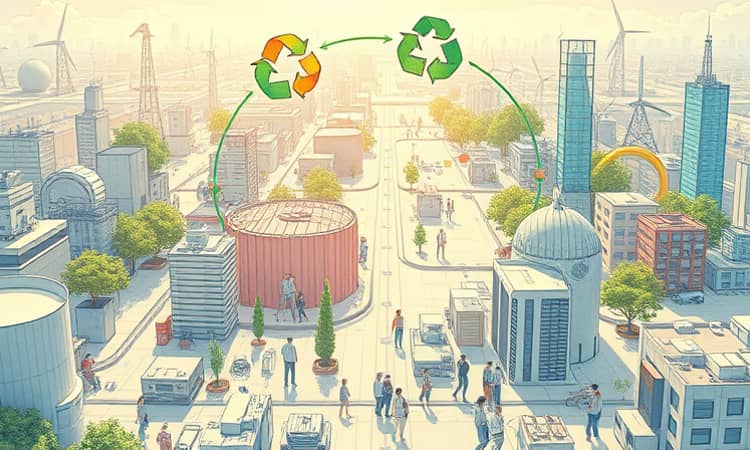
In a world defined by finite resources and mounting environmental pressures, innovative financial approaches are crucial to shift away from the unsustainable linear “take-make-dispose” paradigm. Circular economy finance channels capital into business models that recover value at every stage, fostering resilience, economic growth, and conservation. By aligning investor interests with ecological stewardship, it creates closed-loop regenerative economic models that restore natural systems and build long-term prosperity for industries, communities, and the planet.
Understanding Circular Economy Finance Fundamentals
Circular economy finance involves directing funding toward activities that keep products, components, and materials in use for as long as possible, thus decoupling economic growth from finite materials. This approach spans the entire value chain, from sustainable design and production to maintenance, repair, reuse, and eventual recycling. It challenges traditional metrics by factoring in environmental externalities, resource dependencies, and planetary boundaries, driving a paradigm shift in how financial value is defined and measured.
At its core, this form of finance seeks to transform resource flows by addressing three foundational principles:
- Adopt design for circularity and resource efficiency to extend product lifecycles and ease end-of-life recovery.
- Support sharing economy and product-as-a-service platforms to optimize utilization and democratize access.
- Treat waste as a resource by valorizing waste streams into production inputs and reducing environmental impact.
By integrating these principles, circular economy finance enables companies to innovate, reduce costs, and manage risks throughout volatile global supply chains, while fostering a system where growth no longer relies on ever-increasing resource extraction.
Innovative Financial Instruments Driving Change
A range of investment vehicles and instruments has emerged to back the circular transition. From public equity funds to green bonds and tailored loans, these products channel capital into sustainable infrastructure, regenerative business models, and green technology innovations. Such instruments serve as levers, unlocking new revenue streams, expanding access to funding, and de-risking circular initiatives for both investors and enterprises.
This structured mix of instruments allows stakeholders to align return expectations with sustainability outcomes. Innovative financing not only bridges gaps in capital but also incentivizes collaboration across industries, governments, and communities to build integrated circular ecosystems.
Policy and Regulatory Enablers
Governments and regulators play a critical role in creating the enabling environment for circular finance. Policies that mandate transparency on resource dependencies, integrate circular metrics into financial stress tests, and incentivize sustainable procurement can accelerate private investment flows. Frameworks like the European Green Deal’s Circular Economy Action Plan demonstrate how policy can unlock new markets while safeguarding public interests and the environment.
- Investors and lenders should update risk assessments for resource dependencies and retained value in assets.
- Regulators must standardize circular metrics and definitions to ensure comparability and trust.
- Policymakers can enact fiscal measures reflecting true resource costs in taxation and procurement.
- Governments and central banks should embed circular principles in sustainable finance taxonomies to guide capital allocation.
Through coherent policy frameworks and regulatory clarity, public authorities can reduce uncertainty, lower transaction costs, and catalyze investment in high-impact circular initiatives that deliver societal and environmental benefits alongside financial returns.
Business Case and Opportunities
Circular economy finance is not only a tool for risk management but also a source of competitive advantage. Companies that embrace circular models can unlock hidden value, differentiate themselves in saturated markets, and tap into rapidly growing consumer demand for sustainable solutions. This approach fosters resilience against resource price volatility and supply disruptions, ensuring long-term stability and profitability.
- Enhance resource efficiency and reduce operational costs through reuse of materials and components.
- Tap new markets with innovative sharing and leasing models that meet evolving consumer preferences.
- Mitigate supply chain volatility with closed-loop regenerative economic models and diversified sourcing.
- Create social value and boost brand reputation via sustainability leadership and transparency.
Investors seeking risk-adjusted returns are increasingly drawn to companies that actively manage resource lifecycles. By aligning product design, production processes, and end-of-life strategies, businesses can capture value at each stage and enhance resilience in a rapidly changing global landscape.
Challenges and Transition Strategies
Despite growing interest, significant barriers remain. High-impact design and production innovations often suffer from undercapitalization, while traditional financial models undervalue long-term resource retention. Overcoming this requires targeted interventions that channel funding toward early-stage circular solutions and address market failures in infrastructure and service provision.
Transition strategies often involve phased implementation, cross-sector partnerships, and customer engagement to spread costs and risks. Pilots and demonstration projects can showcase viability, attract additional funding, and build confidence among stakeholders. Companies like Interface have successfully reduced carbon emissions by 69% through material innovations and collaborative supply chain initiatives, illustrating the power of agile, adaptive approaches.
Ultimately, a systemic shift toward circular finance demands robust ecosystem platforms, standardized metrics, and incentives that penalize linear practices. Tools such as private investment trackers and national mapping initiatives can monitor progress, highlight gaps, and guide resource allocation to where it is most needed.
By mobilizing capital, fostering collaboration, and embedding circularity into financial decision-making, stakeholders can co-create a resilient, regenerative economy. This collective action not only secures long-term prosperity but also safeguards the natural systems upon which all life depends.