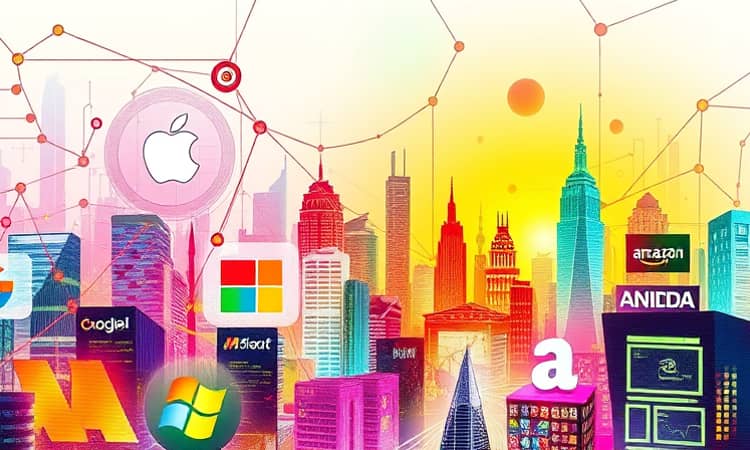
In the ever-evolving digital landscape, a handful of technology behemoths exert a profound influence over global markets and innovation trajectories.
dominate global market capitalization with staggering valuations, reshaping industries and consumer experiences alike.
As of 2026, firms like NVIDIA, Apple, and Alphabet lead the charge, with the technology, media, and telecom sector now comprising nearly 53% of S&P 500 market capitalization, a dramatic rise from previous decades.
This dominance isn't merely financial; it's woven into the fabric of daily life through hardware, software, and cloud services that power everything from entertainment to enterprise solutions.
AI is central to this transformation, driving what experts call the 'TMT eating the world' phenomenon.
The Titans of Tech: Unprecedented Market Power
Big Tech companies, often referred to as GAFAM or GAMAM, have leveraged large domestic markets and robust innovation ecosystems.
achieved unparalleled scale and influence through strategic expansions and investments.
For instance, Apple's revenue surpassed $365 billion in FY2021, while Microsoft and Google continue to set records in their respective domains.
Their control extends across digital ecosystems, from mobile operating systems to advertising platforms, creating a network effect that reinforces their position.
- Alphabet (Google) leads U.S. internet companies by market cap and dominates online search and platforms.
- Apple competes in hardware, OS, and entertainment, with significant brand value.
- Microsoft is strong in enterprise OS and cloud, reporting record revenues.
- These firms build extensive data centers and cloud services for global operations.
This global reach is facilitated by investments, acquisitions, and partnerships that span continents.
innovation ecosystems driving continuous growth have positioned them as central players in the global economy.
Innovation Engine: AI and Beyond
Innovation in 2026 is heavily centered on artificial intelligence, with inference tasks expected to use two-thirds of AI computing power by 2026.
This shift is fueled by massive investments in data centers and AI chips, totaling hundreds of billions of dollars.
The autonomous AI agent market is projected to reach $8.5 billion by 2026, with potential for exponential growth as orchestration improves.
- Industrial robots: Global installed capacity 5.5 million by 2026, with AI driving potential doubling by 2030.
- Micro-series: In-app revenue doubles to $7.8 billion in 2026, challenging traditional studios.
- Vodcasts/podcasts: Global ad revenue $5 billion in 2026, led by emerging markets.
- D2D satellite infrastructure: $6-8 billion by 2026, with about 1,000 satellites for connectivity.
Key trends include AI governance, global market share battles, and a growing tech talent gap.
- Microsoft: Enterprise AI leader with $25-30 billion incremental modernization.
- Apple: Entering consumer AI revolution.
- Google: Strengthened position after antitrust win vs. DOJ.
- China Tech: Narrowing U.S. gap, with bullish prospects in robotics and autonomy.
fueled by massive investments and strategic pivots, these innovations are reshaping entire industries.
Navigating the Challenges: Antitrust and Geopolitics
Despite their strength, Big Tech faces significant hurdles, including antitrust scrutiny and geopolitical tensions.
Google's recent legal victory is a positive sign, but broader regulatory challenges persist.
In 2026, there's a shift towards national control of AI infrastructure, with countries investing in cloud, semiconductors, and data centers to assert sovereignty.
- Antitrust and Regulation: Ongoing scrutiny with more acquisitions expected.
- Geopolitical/Tech Sovereignty: Investments rise, but total sovereignty unlikely.
- Talent and Expansion Barriers: Tech talent gap and complex global entry.
- AI Risks: Enterprise readiness for agent orchestration and interoperability.
- China-U.S. Race: U.S. leads in tech, but China outperforming in equities and robotics.
significant hurdles including antitrust scrutiny require careful navigation to sustain growth and innovation.
Stock Performance: Highlighting Adjacent Players
The stock market reflects this dynamic, with tech stocks projected to rise 20-25% in 2026 driven by AI advancements and market optimism.
This performance highlights not just Big Tech but derivatives and adjacent companies benefiting from the tech boom.
adjacent companies showcasing robust growth illustrate the broader impact of technological advancements.
The Broader Ecosystem: Players and Prospects
The competitive landscape extends beyond Big Tech to include challengers, derivatives, and international firms.
Companies like AMD, Cisco, and Palantir are key players, while China's Alibaba and Tencent are closing the gap.
- Big Tech: NVIDIA, Apple, Alphabet, Microsoft, Amazon.
- Challengers/Derivatives: AMD, Cisco, IBM, Palantir, Intel, hyperscalers like Oracle.
- China: Alibaba, Tencent, Baidu, Huawei.
- Startups/Major Firms: 30 key companies shaping trends.
M&A activity is intense, with Big Tech's $600 billion CapEx fueling acquisitions and global expansion.
extending beyond Big Tech to diverse players creates a vibrant and competitive environment.
Future Outlook: Embracing Change and Opportunity
As we look ahead, the tech sector is poised for a bull market in 2026, driven by AI and innovation.
With only 3% of U.S. companies deeply engaged in AI, there's immense room for growth and disruption.
This era demands strategic thinking from businesses and individuals alike, urging us to harness technology for positive impact while addressing ethical and competitive concerns.
The journey ahead is filled with opportunities to innovate, compete, and shape a more connected world.
driven by AI and continuous innovation, the future holds promise for those who adapt and lead.